
Though Bay Area weather forecasters continue to characterize our prolonged dry spells as a drought, it is best to remember that we live in a Mediterranean climate, one defined by long dry summers. Rainy winters versus dry ones will come and go but as avid gardeners, it makes sense to be looking at plants that will thrive in our gardens with little summer water. Fortunately, there are a great variety of plants that fit the bill, from ground covers, to low perennials and shrubs, as well as plants that are best described as embodying xeriscape qualities. And many of these plants are California natives, plants that have adapted to thrive in our summer dry Mediterranean-like climate.
Many of these plants will be familiar to the enthusiastic gardener. This article looks at the idea of intentionally planting part or all of your garden with our summer dry climate in mind. That is, rather than planting a few of these summer dry plants scattered throughout the garden, here we are looking at creating a whole bed or in some cases, a whole garden, filled with these plants. As there are endless planting schemes, in this article we’ll keep the focus on the many plants that are suitable for a Mediterranean garden.
Shrubs
Here are a few of the many drought tolerant shrubs. There are almost endless ways to group these in the context of a planting scheme and one way is by leaf color. As it happens, a number of our choices offer a wonderfully silvery cast. Leading the way are four lavenders, each with its own character.

Whether it’s the classic English lavender (L. angustifolia ‘Munstead’ or Lavandula angustifolia ‘Royal Velvet’ “Culinary Lavender”), with its grayish-green 2′ high foliage, Spanish lavender, with the wine-colored winged flowers (L. stoechas ‘Lutsko’s Dwarf’ or the vividly silver ‘Silver Anouk’) or the popular L. x intermedia hybrids (‘Grosso’
or Lavandula x intermedia ‘Phenomenal’ “French Lavender”), lavenders are intensely fragrant, very drought tolerant and a magnet for bees.

Two California natives offer their own charms. California sagebrush (Artemisia californica) forms a dense 3-4′ high bush of silvery foliage. Durable and exuding that unique fragrance, it’s perfect for a dry garden bed.
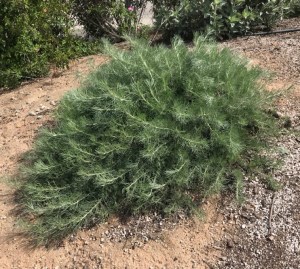
By contrast, A. californica ‘Canyon Grey‘ stays lower, topping out at one foot tall but spreading to four feet wide. Its feathery foliage is a little greener but is equally aromatic. This variety makes a perfect high ground cover for a hillside or for covering a problem area.
Dwarf Coyotebush (Baccharis pilularis ‘Pigeon Point’), found growing throughout the dry chapparal slopes of northern California, forms a low dense mound 6-8’ wide and 1-3’ tall. Ideal for slope stabilization, it accepts many kinds of soils from clay to sand and watering regimes from moderate to none. It is the perfect choice for a slope that doesn’t receive much care.
California lilacs
Dry garden shrubs need not be uninviting. California lilac (Ceanothus) offers many species, each with dazzling purple or blue flowers. Of the 5 varieties we carry, 3 are particularly showy. ‘Julia Phelps’ gives other varieties a run for their money with a cloud of the richest indigo-purple blooms in spring. Gorgeous! To 6-8’ H&W, it is also fragrant in and out of bloom

Meanwhile, Ceanothus thyrsiflorus ‘Skylark’ has a more compact 4’ x 4’ habit, making it a good choice for small gardens and large decorative planters. Come summer, its small, evergreen foliage is practically smothered with round clusters of captivating violet flowers. Lightly fragrant, they are loved by bees and butterflies.
And for a taller form, the ever-so-popular ‘Ray Hartman‘ is a long blooming 8-10′ tall variety. It is just amazingly floriferous! California lilac varieties are one of best plants for attracting pollinators and songbirds to your garden, they are deer resistant and they can prosper with very little summer water.

More Splendid Shrubs
Speaking of natives, do you know about our wonderful native Verbena (V. lilacina ‘De la Mina’)? Exploding into a cloud of rich, lavender-blue flower clusters in spring, this 3’x3′ ‘plant & forget’ native blooms nearly year-round. Versatile for placement in both cottage and dry gardens, it also dramatizes a decorative container. Butterflies and bees adore the lightly fragrant flowers and it thrives in a range of soils, from sandy to clay.
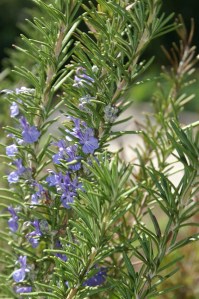
And though it’s not a native, the Bay Friendly aromatic shrub Rosemary (R. officinalis) offers all the advantages of a native (adapts well to our summer dry environment and attracts local pollinators). Annie’s sells 3 varieties, each with its own character. ‘Barbeque’ is a full-sized shrub (6′) with stiff stems that can be used for BBQ skewers. It has wonderfully fragrant foliage, topped with dancing flames of pale violet flowers.
‘Taylor’s Blue‘ meanwhile forms a more compact 2’x3’ shrub, with slightly arching branches and glossy green, irresistibly aromatic leaves. Long-lasting, lovely pale lilac flowers open in spring. And there is a low growing rosemary, perfect for landscaping. ‘Huntington Carpet’ is the perfect evergreen “spiller” plant for tough conditions and looks dramatic draping over a rock wall, This rosemary is crazy-tough, even in windy, coastal conditions, and is smothered in deep purple blooms winter through spring. Rosemary plants are among the hardiest plants you will ever grow, thrive under a wide variety of conditions and their flowers are absolute bee magnets!
Bush marigold (Tagetes lemmonii) Many a gardener is familiar with this easy-to-grow, bushy marigold. Smothered in cheerful 2” daisy-like yellow flowers nearly year-round, it also features finely dissected leaves renowned for their citrusy scent. Tolerates clay and poor soils. Deer resistant and drought tolerant, it is a valuable food source for hungry butterflies and bees during winter’s scarcity.Sages. Though there isn’t space here, Annie’s sells a great many Salvias, including native selections such as S. apiana, S. ‘Bee’s Bliss’, S. clevelandii, S. ‘Pozo Blue’, S. somalensis and S. spathacea.

Low Growers for Summer Dry Gardens
Almost every garden has need of one or more low growing perennials, be that to cover an open area, for cascading over a low border or even to cover a problem area. Fortunately there are a great many utilitarian plants that offer their own beauty.
California Buckwheats
These versatile natives (Eriogonum species) are one of the very best resources for attracting pollinators to your garden. Flowers provide nectar for bees and butterflies especially and the seeds are harvested by a variety of songbirds. Each one is drought tolerant and can handle poor soils.

Start with everyone’s favorite – Red Buckwheat (E. grande rubescens). It produces an abundance of grayish-green leaves, silver underneath, then come summer, tall stems of little rosy-pink flowers. Blooming all summer and well into the fall, it immediately attracts bees and butterflies to its nectar-rich flowers. Leave the browning flowers on the plant and soon songbirds will come to harvest the developing seed.
Sulphur Buckwheat (E. umbellatum) exhibits all the virtues of red buckwheat but has fuzzy, bright yellow flowers. The spoon shaped, silvery-green leaves last year round and form a neat, compact mound 4-8” tall. Meanwhile, Seaside Buckwheat (E. latifolium) puts on a dazzling flower exhibition from spring through fall, the silvery-pink flowers seeming like something out of a Monet painting. Make sure to give these buckwheats excellent drainage and a touch of summer water and they will put on a dazzling summer and fall exhibition.
Sticky Monkey Flower
No question, there is a big fan club for this California native (Mimulus species). In fact, one could make a case that the drought tolerant group of Mimulus selections are the perfect plant. Long blooming, beloved by pollinators, very drought tolerant and able to prosper in contrary conditions, well, what else could you ask for? Start with the classic form (M. aurantiacus ‘Pt. Molate’).
It produces an abundance of creamy orange flowers on plants that are 12-24” tall and a bit wider. This native’s common name derives from its sticky stems, a quick way to tell if you have one of the drought tolerant varieties.
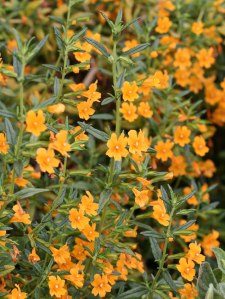

Or how about the fabulous new M. ‘Changeling’? This aurantiacus cultivar has rosy-red throats and yellow edges. Each flower seems to have its own color combo! And we are proud to offer several varieties in the Jelly Bean mimulus series. JB ‘Betabel’ is a vivid dark red and blooms all summer & fall, while the popular JB ‘Fiesta Marigold’ offers striking red flowers bordered in yellow. We’ve had many a visitor to our nursery who exclaims “Wow, that’s a Mimulus?!” Monkey Flowers are proof that you don’t need to be lacking in luster if you’rea native dry garden plant.
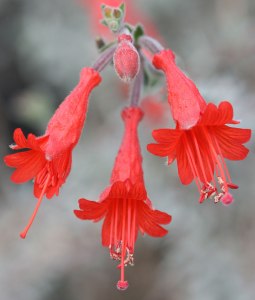
That sentiment is echoed by California fuchsia (Zauschneria). Incredibly drought tolerant and a prolific bloomer, this cascading ground cover is the ultimate ‘spilling’ plant.
Its silvery foliage and coral red flowers (Z. californica), plus its dense habit and durability, make it ideal for rock gardens, dry garden beds, even problem areas. The same is true for Z. canum ‘Sierra Salmon’, with its pretty reddish-salmon tubular flowers. Both California Fuchsias are hummingbird magnets, making this evergreen native one of the very best plants for attracting our winged friends to your garden.
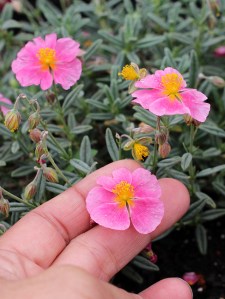
Lastly, there are two other low growing plants that fit in nicely with a summer dry garden scheme. Sun Rose (Helianthemum nummularium) is one of those ground covers that deserves to be in everyone’s garden. Very low, dense foliage – from grayish-green right up to shiny green – forms a dense mat and then with ‘Henfield Brilliant’, vivid 1/2” orange flowers appear in summer. Or go pink with ‘Belgravia Rose’ and its soft pink flowers. Both varieties are very drought tolerant once established.
Coyote Mint may seem like an odd name but California native Monardella villosa ‘Russian River’ will make you a fan in short order. A bit taller than most ground covers (12-18”), it produces small grayish-green leaves and come summer, scads of lovely purple globe flowers. Bees and butterflies adore the flowers and you will love the aromatic leaves. Very drought tolerant once established, this is one of the great pollinator plants to add to your summer dry garden.
Xeriscape Exceptionals
Xeriscape can be defined as ‘needing little or no water’ and that is true for this collection of outstanding summer dry denizens. Agaves, aloes and yuccas have long been featured in some of the more spectacular ‘dry’ gardens, where their unique forms and subtle colors add an invigorating element to many a planting bed. They are each highly adaptable to dry gardens, many being endemic to deserts or arid landscapes. And Annie’s carries a number of these wonderful plants.
Agaves
Agaves are architectural plants, displaying rigid forms that have a spare beauty, and nowhere is that more evident than with the elegant A. ‘Blue Glow’. This 2’x3′ hybrid
agave creates a beautifully symmetrical solitary rosette.
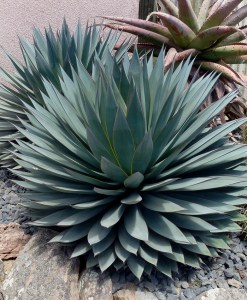
Chalky blue in color and edged in red and yellow, it stands out in any design. Multiple plantings can create an intriguing atmosphere. To help it thrive, give it a little water during hot & dry summers. Though it is slow growing, it eventually makes offsets. Hardy to 20-25° F.
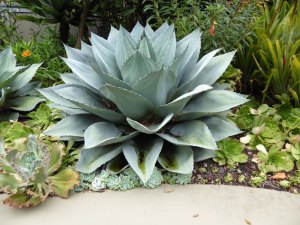
For a more dramatic display, consider adding Whale Tongue agave (A. ovatifolia) to your garden. It forms a rounded rosette of short (8-12”) wide leaves that are distinctively cupped. Mature plants can reach 2-5’ tall and 3-6’ wide over an 8-10 year period. Each shimmering, powdery-turquoise leaf has tiny rigid teeth ringing its perimeter.
Though it is slow to bloom, that 10-14’ tall spike sports eye-catching chartreuse flowers. Hailing from NE Mexico, it’s one of our most cold-hardy Agaves, hardy down to 5 degrees F.Speaking of showy flowers, the Cape Aloe (A. ferox) sports spikes of vivid orange flowers much beloved by hummingbirds. These 2-4′ tall spikes, up to 5-8 at a time!, appear in winter and spring. Cape aloe also features dense rosettes of bluish, lance-shaped leaves, up to 3’ long with a spiny surface and reddish-brown, toothed edges. Especially adaptable to rock & dry gardens or sloping hillsides, it also enlivens large decorative containers. And check our Annie’s website for the availability of many other wonderful aloes.
Yummy Yuccas
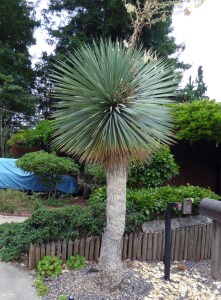
For a spectacular focal point, look no further than Yucca rostrata ‘Sapphire Skies.’ Extraordinary beauty and bold architectural form make this winter hardy selection a fantastic choice for a dry garden. It begins by forming a 3’ x 3’ rounded dome of slender, flexible, jade-green leaves, perfect as a stunning structural accent. In year four, it develops its signature thick-textured trunk (to 15” diameter), topped by a 3-4’ spherical head of the loveliest powder-blue foliage. At maturity, huge candelabras of creamy-white flowers are displayed above the foliage. Hardy to -10 degrees F.
By contrast, Yucca filamentosa ‘Color Guard’ offers up bright green leaves, enlivened by a vivid yellow central stripe that turns pink in cold weather! Each rosette produces a single flower spike in late spring-summer, reaching up to 6’ high and dripping with pendulous iridescent-white blooms. A smaller specimen, ‘Color Guard’ forms a 2-3’ high and 1-2’ wide rosette – the perfect size for any garden!

Care
Many of us have drip irrigation in our gardens and this is an excellent system for most plants. Summer Dry plants, once established, won’t need this regular water and in fact are better off not connected to any drip irrigation at all. Occasional deep watering will encourage strong and deep roots, whereas a small amount of regular water from drip irrigation will create an unwanted shallow root system. Every plant mentioned above has the ability to thrive with very little summer water. As there is great variation in the amount of water needed, please check your gardening source for that plant’s particular needs. Most of these plants require fast draining soil and can do nicely with sandy or rocky soils. If being planted in the ground, make sure to amend the soil liberally with sand, pumice or an extremely fast draining soil mix. Give them a bit of regular water while they are establishing, after which, most will need little or no summer water. Fall is generally the best time to plant.
Availability
Just so everyone knows, some of the Annie’s Annuals plants mentioned here might not be available on the week that you’re reading this blog article. Some of the plant varieties discussed are only available in our retail nursery in Richmond CA. This is generally due to us only being able to grow small crops or the fact that the particular plant does not ship well. A quick look at that plant’s page will let you know if it’s available. If not, just click the Add to Wishlist button and we’ll notify you when that plant is ready to take home



 blog.anniesannuals.com
Leave a Reply