Archive by Author

Dwarf Madness!

20 May

What in the world has happened to garden center plants, people? Sunflowers and Asters in bloom at only  4” tall? Nicotianas with no scent and Dianthus that die a month or less after planting? Yes dear gardeners, this nasty trend which started more than 10 years ago is accelerating quicker than you can squash a bug. Last February, in front of my neighborhood supermarket, I felt super horrified as I noticed the African Marigolds on display by the front door. They were in full bloom (in 6 packs!) at no more than 5” tall. Gadzooks!

African Marigolds? Or tennis-balls-on-a-stick?

DOD MARIGOLD HABIT 55

Ahhh, that's better. Day of the Dead Marigolds growing to a proper 3' tall.

African Marigolds are supposed to be huge. To 3 or more feet tall and 3 feet across. If you’re a young gardener, you may not even remember them being so grand and fabulous with their bushy multi-branching form and loads of 4”-across, extra double, dense blooms fantastic for cutting. Here at the nursery we call them “Day of the Dead Marigolds” as they are still grown in Mexico and South America to create altars and stunning displays for the holiday.

How incredibly fabulous is this? The red flowers are Celosias! Many more gorgeous Marigold images at http://flavorsofthesun.blogspot.com/2010/11/images-from-day-of-dead.html

So you can imagine my chagrin to see what the nursery industry has done to them, all in the name of being able to serve the customer what they say we want – 6 packs and 4″ pots in full bloom. And for heaven’s sake it was February ! Umm … freezing! Obviously, they were greenhouse grown, so now you can watch them die in your yard from the cold which they are so not fond of.

I know that “each to his own” and I’m glad when anybody gets outside and digs their hands in the earth, but don’t you think it’s sad that taller varieties, with all their grace, lovely form and charm are being pushed out (and forgotten), only to be replaced with squat, charmless blobs of color? What can you do with them? Line them up like orange and yellow tennis balls just like at the gas station? Nice.

What can we say? We have no words.

More and more plants are being sold all dwarfed and squatty. Many of our seed sources are dropping the taller varieties across the board and it has become harder and harder to find original proper sized species.

Here’s another calamity :

Wait a minute, what's going on here?!

Photo courtesy Karen Cairone. http://lifeamongtheleaves.blogspot.com/

Okay, you gotta give the person who designed this carpet bedding some points here for being creative with what they had to work with. But wouldn’t you prefer your Ageratums to look like this?

Ageratum Blue horizon in pot   2

Ageratum houstonianum growing to its rightful height of 3 feet.

To 3’ tall and 30” across, Ageratum houstonianum ‘Blue Horizon’ has big, fluffy, butterfly enticing, sweetly scented flower clusters – great for cutting. That’s a 15 gallon pot you see here and those blooms lasted for months. When dead headed they go on blooming all summer! That’s another big problem with those boinky dwarf plants. The bloom time is very short, especially when they’ve been blooming at the growers and then at the garden center before someone comes along to buy them.

Okay, one last depressing example. Dianthus. Dianthus is one of my all time favorite, awesome and reliable perennial standbys. They’re in full bloom in my back yard and at the nursery right now and they are really, really showy. They totally make my gardens pop with their profuse bloom and romantic colors and fragrance.

dianthus pinkerton purpleton

Dianthus 'Pinkerton' blooming its heart out at the nursery.

Truthfully I don’t think you can even find them at many nurseries or garden centers any more. Because they’ve been replaced with this:

Boink-o-rama!

These are Dianthus sinensis. Squat, die-pretty-darn-fast, scentless and disappointing annuals (which are often sold as perennials!). They grow to 6” tall at best. You’ll never see them bloom like the one plant of Dianthus plumarius ‘Pinkerton.” Nowadays, I’m afraid a lot of folks think I’m delusional when I tell them how much I love my Dianthus. Our beloved “Pinks,” (Dianthus plumarius and D. gratianopolitanus) are one of the oldest of all cultivated perennial plants and they are in danger of becoming so obscure and hard to find that they may soon be banished to garden memory oblivion. It makes me sad that up and coming young gardeners may never discover how great they are.

Lastly, a great garden includes plants of varying heights, forms and textures, of course. But with these “box store” offerings, everything ends up being the same size! Well, that’s not very fun. And I don’t think it’s as aesthetically pleasing – or rewarding enough – to really draw folks into the wonders of gardening.

Mother’s Day Love Fest!

12 May

Watch a slideshow of our Mother’s Day Extravaganza!

Thank you everybody who came to our fabulous Mother’s Day Party last weekend! I always say Mother’s Day is my favorite party at the nursery and this year was no exception. Everyone is always in such a splendid mood and the gardens are at their showiest!

Glorious Spring!

Glorious Spring!

Fortuna & Lupinus GOOD
Fortuna dressed in her Mother’s Day floozie finest!

We are always so delighted and touched to see so much love and so many big happy smiles all around us.

Ava & Nancy

Mom and Daughter in law are all smiles.

upsidedown!

Everything looks better upsidedown!

Mom love!

Give your mama a squeeze and say cheese!

And, as always, we had so much fun with our big Queen for a Day winners and thrill-seeking Musical Chairs contestants!

Queens!

Saturday's Queens for a Day won 15 minutes of FREE shopping!

Another one bites the dust

The last gardener sitting wins a $100 gift certificate!

I felt like I won the grand prize when one of our visitors showed up in my ultimate dream car – a 1957 Plymouth Belvedere. Lovingly restored, it was turquoise inside and out with gold lame interior trim. Be still my beating heart! I even got to go for a spin around the parking lot!
Me in Plymouth
And then the day got even better when my eldest son surprised me by showing up at the nursery on Sunday. Without warning, he had driven up from LA, making me the happiest mom in the world!

5705302468_ffb44a5dea_o

Me and my big boy!

Watch a slideshow of our Mother’s Day Extravaganza!

Spring at The Wave Garden

4 May
Great news! Kellee Adams of Dig-It Landscape Design and the plantswoman behind the Wave Garden is speaking at our Mother’s Day Party on Sunday, May 8 at 11 am! She’ll be sharing her fun and creative approach to “Plant Marriages” using “show-off” contrast combos, color and texture that you can bring to your own garden.  Don’t miss it!

Sweeping views of San Pablo Bay, wave-inspired peach-tinted concrete walls, hand-forged wrought iron metalwork and delightful sculptures wow visitors who step through the gates at the Wave Garden in Point Richmond, CA.

Entrance to the Wave Garden, Point Richmond

Entrance to the Wave Garden, Point Richmond

Entrance path

Winding paths and rich textures greet visitors

A frequent visitor to our nursery, designer Kellee Adams has created a wonder-filled refuge for birds, butterflies, bees and people. And good news – it’s open to the public!

Visiting with Kellee this week, we were inspired by her artful and sophisticated plant groupings featuring many South African and Canary Island favorites. With a background in graphic design, Kellee is a master at combining texture and contrast while still tantalizing the eye with plentiful blooms.

Leucospermum vert

Leucospermum 'Spider'

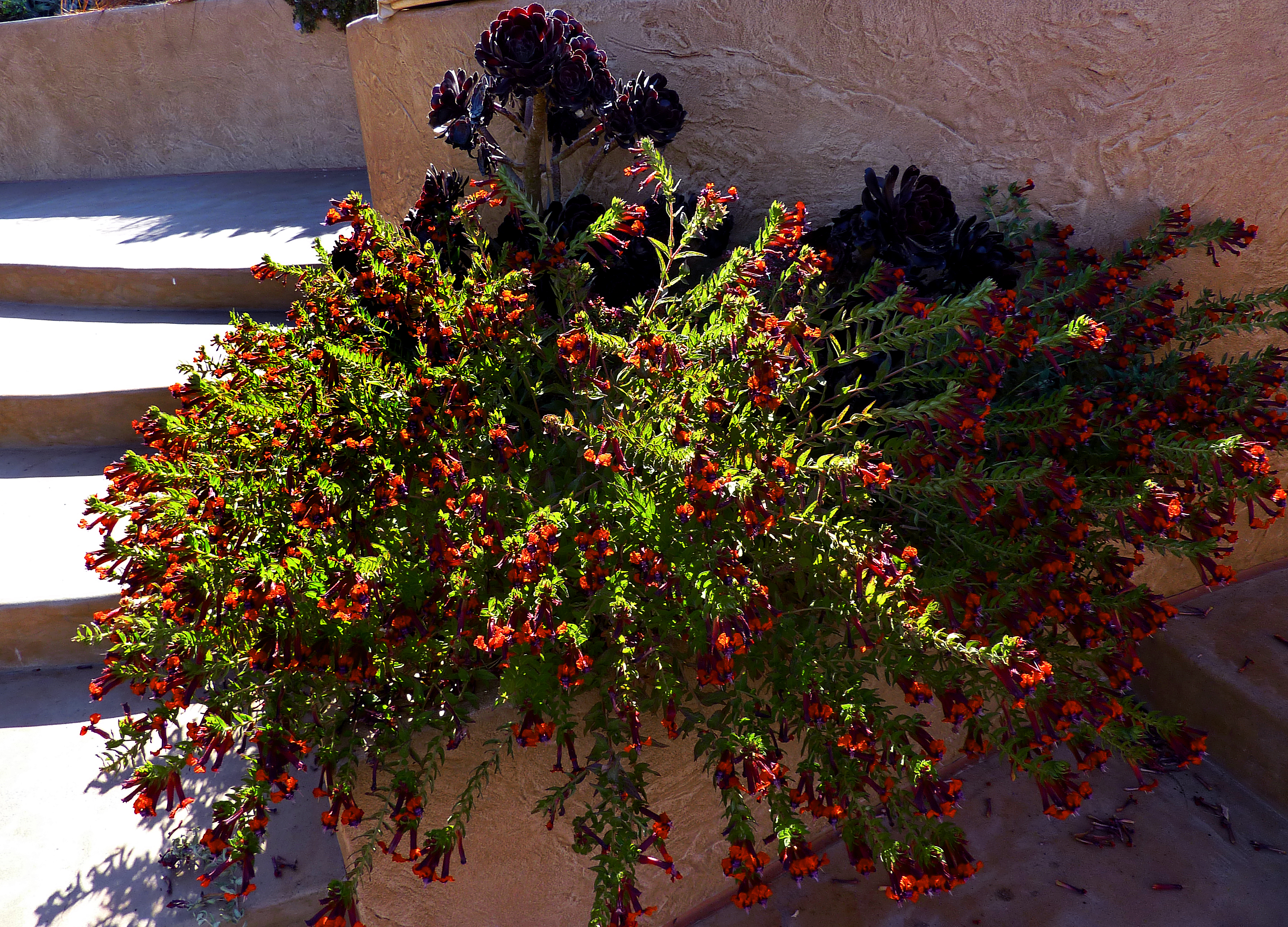
Cuphea llavea "Bat Face Cuphea" blooming its heart out last September

Low water and low maintenance, no view-blocking trees and lots of blooms were the only instructions from the owners, Jeanne and Vern Doellstedt, who bought the lot to prevent it from being developed into another house. They initially hired concrete artist Victor Amador to build paths, staircases and terraces around a beloved sculpture of a whale’s tail by artist Douglas Purdy. Wrought iron railings and gates by local blacksmith Bobby Sharpe added a grounded but whimsical touch.

Whale's tail

The garden was built around this bronze sculpture by artist Douglas Purdy.

Kellee was given the freedom to put her artistic talents to work. We very much like how she successfully incorporates bold succulents into her design, often softening them with smaller bloomers and more delicately foliaged plants.

Pelargonium and Aeonium

A study in contrast - cute little Pelargonium and bold Aeonium.

adorable pelargonium

Chondropetalum & Euphorbia Wave Garden

Chondropetalum and Euphorbia creating lighting drama!

Kellee explained to us how she enjoys juxtaposing contrasting plants that capture light and dark, bringing excitement and dimension to the senses. We’ll let Kellee explain it herself:

The Wave Garden is located at the end of Grandview Court in Point Richmond and parking is extremely limited. If you visit, please be respectful.

Watch a SLIDESHOW of our visit to the Wave Garden on Flickr!
Find out more about our Mother’s Day Extravaganza 2011!
Check out Kellee’s website for more information about her gardens and services!

It’s starting to happen!

28 Apr

Looks like the gardens will peak just in time for our Mother’s Day Party on May 7 & 8! Get all the deets HERE!

Everything is blooming about a month late because of the cold and the rain and the hail (and the rain an the hail and the cold). We didn’t know if this year’s gardens would end up a complete disaster after an unusually brutal Winter but once again, Mother Nature is delighting us with her magic.

lupinus_thomas_church_garden

Lupinus 'Thomas Church' and Aquilegia v. 'Blue Barlow' looking spiffy!

The California natives seem to be especially slow, with California poppies yet to bloom and Nemophila menziesii “Baby Blue Eyes” growing in slow motion. But, the Lupines are earlier than ever and thriving!

lupinus_thomas_church_spiking

Omphalodes linifolia provides a delightful white skirt to our boy 'Thomas.'

Layias were one of the CA natives not affected by the rain and it didn’t seem to mind the cold. Some of them did get a little beaten down by the hail, but they’re sure bringing their rays of sunshine to the beds right now.

LAYIA & PHYGELIUS CROP PRETTY ADJ  copy

Layia platyglossa "Tidy Tips" and Penstemon pseudospectabilis with Campanula glomerata.

layia_glandulosa_in_garden

Layia glandulosa makes the perfect partner to Nemophila menziesii "Baby Blue Eyes."

We’re LOVING the true form of Layia glandulosa. Everybody loves blues and whites in the Spring garden, but you need soft yellows to balance it out and bright pinks to make it pop. I’m so excited because this is the perfect soft yellow to go with all of our Spring bloomers!

Gladiolus carneus "Painted Lady" & Glaucium grandiflorum GOOD copy

Gladiolus carneus "Painted Lady" and Glaucium grandiflorum make odd bedfellows.

Every year is different and full of surprises. I’ve never seen these two plants bloom at the same time before, hence the unusual color combo! That’s Gladiolus carneus, a South African bulb, returning for another year and Glaucium grandiflorum (orange), blooming much earlier than it usually does for us. Both require no Summer water.

Just coming into bloom is Delphinium belladonna ‘Cliveden Beauty’, Sidalcea hendersonii and ultra-blue CA native Phacelia viscida. The Sidalcea is one of my favorite perennials, I use it everywhere because it blooms Spring thru Fall and is so very reliable, becoming bigger and bloomier every year.

Sidalcea hendersonii & Phacelia viscida Garden  copy

From left to right: Delphinium belladonna 'Cliveden Beauty,' Sidalcea hendersonii and Phacelia viscida.

Phacelia viscida

Bumblebee magnet Phacelia viscida how we love you!

Believe it or not, there are a whole lot more plants still to bloom in this garden. I think they should hit their peak just in time for our Mother’s Day Party on May 7 and 8. How cool is that? You should definitely come – bring your Mom AND your camera! MORE ABOUT THE PARTY HERE!

spring_garden

Carnival colors: Greek poppies (red), Layia platyglossa (yellow), Cheiranthus allionii (orange), Eschscholzia caespitosa (shortie yellow) and Aquilegia c. "Rocky Mountain Columbine" (light blue in background).

Our Favorite Tomatoes!

15 Apr
Though we work in relative harmony here at “Annie’s” there are some things we don’t always agree on. Most of the time, we can work through our differences, but when it comes to important topics like tomatoes, we square off. We’ve grown all of the tomatoes we offer and have selected the best ones for our cool-Summer climate. Here are our top picks! (My choice is the fourth one down – just skip the others and read it first since my tomato is CLEARLY the best!).
Currant tomatoes

Red Currant tomato. Photo courtesy Scott Ashkenaz on Flickr.

Tomato ‘Red Currant’
Annie Hayes “The Boss”

I grow these extraordinarily prolific wild cherry tomatoes in 2 half barrels in my driveway, so when I get home from work I’ve got an awesome snacky pick-me-up before i even hit the front door. Also, I eat a lot of salads and I love how I don’t have to slice these little guys – just toss ’em in. At never more than 1″, they’re just the right size! Unlike typical cherry tomatoes that are just simply sweet, ‘Red Currant’ bestows a real tomato flavor overlaid with a hint of sweetness – totally delicious! What’s more, I think they bear longer than any other tomato starting early and lasting through November. You’ll get zillions of them and even if you miss a few, you certainly won’t worry about it – they just keep coming and coming. You may even have to come up with new tomato recipes (cherry brownies maybe?) if you want to eat them all. Interestingly, they are a different sub-species from all the other different cherry tomatoes. Indeterminate, they’ll grow to 5′ so use a cage or stakes to hold up all those fruit-laden stems!

tomato_thessaloniki

Big juicy acidy tomatoes are attainable in our cool-Summer climate! (Heavens part, angels sing!)

Tomato ‘Thessaloniki’
Annie Hayes – “The Boss”

I remember way back in the early 60’s, on hot Summer afternoons, my mom serving us kids the most absolutely delicious sandwiches that we kids would eat out on the back porch. They were stuffed with large, fat slices of tomatoes that tasted like heaven. Up until a few years ago I never again tasted, grew, or bought a tomato that matched my memory of this “Holy Grail” true acidy “Summertime” flavor until I grew my first ‘Thessaloniki.’ And lo and behold it hails from the town my dad was born in! A huge, vigorous indeterminate variety, it bears a great number of beautiful large red fruits that take forever to rot or go mushy when left for a long time on the vine. No splitting either and it’s very resistant to blight. It does make a lot of dense foliage (to protect against the intense Greek sun and heat), so I just pull off leaves that block the sun from hitting the fruit here in Summer-foggy Richmond, CA. I do pinch out the suckers for bigger sized tomatoes. If you’re looking for a big, productive, easy to grow old-fashioned tasting tomato, I highly recommend this one and I’ll bet you grow it every year from now on!

BWPS (Big White Pink Stripe) is neither white nor striped. Go figure. Photo courtesy Kelly Kilpatrick

Tomato ‘Big White Pink Stripe’ or ‘BWPS’
Claire Woods – Production manager

The all around winner in my failure of a vegetable garden last year and not just because everything else tanked. Though this tomato is neither pink nor striped, it is by far the most interesting and delectable tomato I’ve tried. It’s sweet with dense flesh, good smooth texture and rich fruity flavor – if ever there was a dessert tomato, this is it! I’ve never had another tomato like it and my plant produced fruit when no other did in last year’s over-cool summer. Fruits are big – like the size of a juicy peach, but squat and irregular shaped. They’re roughly peach in color, too, with a wee bit of mottling on the skin that I guess someone decided was enough like stripes to add “Stripe” to the name. Like a lot of lighter colored tomatoes, it’s very low acid, which for me is perfection. Though Annie likes ‘em tart, she can have her ‘Thessaloniki!’ More ‘Big Pink White Stripe’ for meeee!

Sandwich seduction: Black and Brown Boar from Wild Boar Farms

Tomato ‘Black and Brown Boar’
Elayne Takemoto – Marketeer

No one loves tomatoes more than me, which somehow doesn’t match well with how notoriously lazy I am when it comes to taking care of my tomato plants. I don’t baby them, I don’t fertilize and half the time I end up planting them where there’s room – not where they’ll do best. Well, last year, my urge for the perfect BLT was strong – I was motivated. I cleared all of the plants out of the deep planter between my concrete driveway and a low brick wall – the warmest, sunniest spot on my foggy, cool property. The soil was nice and friable, I added compost and I watered on an every-other-week schedule until the fruit set. I kept weeds at bay, I doted, I waited. If you were around for last year’s notoriously cool “Summer,” then you’ll know that I waited well into August before I got my first tomato – but boy was it worth it! This luscious, juicy, slightly tart beauty was ‘Black and Brown Boar’ from Wild Boar Farms. It was a tomato that tasted like a TOMATO – all caps! I sliced up some fresh sourdough, grilled up some facon (fake bacon – highly recommended), gave it a generous swipe of mayo and dusting of salt and cracked pepper and voila! Pure heaven. You bet I’m growing it again. Indeterminate. 65-75 days.

Big, bold Pink Berkeley Tie Dye from Wild Boar Farms. Photo courtesy Kelly Kilpatrick.

Tomato ‘Pink Berkeley Tie Dye’
Kelly Kilpatrick of Floradora Garden Design

As a gardener living in a cool season locale, I always thought that big ol’ hunky tomatoes were unattainable, needing more heat to mature than I could provide. After growing lots of the cherry-sized varieties I decided to give ‘Pink Berkeley Tie-Dye’ a try. What ensued could only be described as a tomato love fest! A sturdy girl with surprisingly robust stems, she’s not one to be caged and quickly outgrows any boundaries, best grown up a tall stake or trellis. The hefty fruits have lovely pink flesh, the skin of which is a beautiful rose streaked with gold. Produces LOTS of tomatoes that are wonderful as thick slices on sandwiches or lightly sauteed with olive oil, garlic and basil for a true Summer of love.

tomato_stupice

Small to medium sized but Mighty in old-fashioned flavor: Stupice!

Tomato ‘Stupice’
Marti B. – Wholesale assistant extraordinaire

After too many disappointments trying to grow a tasty tomato in our foggy neighborhood, including the variety tauntingly named ‘San Francisco Fog’, I gave up and swore off tomato growing. Then one day at the nursery I saw we were growing  ‘Stupice’ and I remembered years ago a neighbor had given me a start for this plant. Even after over watering, planting too early and just about every other novice mistake I could make, it produced the most yummy, acidic and old fashioned tasting tomato I’d had in years. So I got back on the tomato wagon with ‘Stupice’ and my reward was an abundance of perfect tasting, completely non-mealy, tangerine sized tomatoes. In foggy zones, late planting (harvest will be late Summer) and brutally witholding water once fruit sets are the keys to the tastiest, non-mealy tomatoes.

CHECK OUT ALL OF THE DELICIOUS TOMATOES WE GROW!
They’re coming VERY SOON, add any variety to a WISH LIST to get an automatic email just as soon as the crop comes available. 

Our AMAAAZING Spring Party!

13 Apr

Donkeys and owls and dragons – OH MY!

Big, BIG thanks go out to all our gardening friends, who made this year’s Spring Party the biggest, best and funnest EVER!

And a beautiful day was had by all!

A beautiful day was had by all!

We were so lucky to have incredibly Springy weather with blue skies and big puffy clouds – a perfect setting for a weekend of fun, flowers and extreme silliness.

The day started out with our Cuckoo Mookoo Costume Contest and we have to say, the costumes this year were INCREDIBLE. Octavius Seymour the Owl, Snappy the Snap-Dragon and the beautiful Bachelor Buttoness to name just a few!

The Wild Bunch

Snappy the Snap-Dragon and Friends

The Owl and the Fairy

Octavius the Owl and the Spring Fairy

Costume Winner ! "Bachelor Button" dress made from crepe paper !

The Marquesa of Bachelor Buttons - in a handmade dress of crepe paper! Incredible!

How lucky were we to also have two outstanding speakers – Kate Frey and Amy Stewart. Both talks drew big crowds and were packed with so much good information on habitat gardens (Kate) and eeeeevil plants (Amy).

Pollinator Talk!

Pollinator crusader Kate Frey told us all how to bring more pollinators to our gardens.

Amy Stewart

Amy Stewart's talk about wicked plants had us itching to put on gloves and goggles before gardening.
And what’s a party without a few surprises? Cassie of Gardengirl Farms brought adoptable chickens and bunnies and Michael Layefsky, aerial photography enthusiast and gardener, showed up to take pictures of all the shenanigans with a camera attached to a 25-foot pole.

Look up & say CHEESE!

Aerial pole photography rig. Cool!

there we are!

Here we are! Photo courtesy Michael Layefsky.

Young and old were delighted when the cutest miniature donkey named Little Willow walked through the gate, all dressed in flowers for the costume contest.

costume Winner! Little Willow and Mama Willow.

Little Willow the Donkey with her mom Willow.

Unquestionably, the most fun happens at the games! First up was the Supermarket Sweep raffle – where two lucky people win 15 minutes of FREE SHOPPING! We like to see their little red carts piled as high as they can go!

Saturday sweepers with their haul

Saturday's Winners and their haul!

And where else can you become a Gardening Olympiad for how fast you can coil a hose or how accurately you can fling extremely lifelike pieces of cat-poo? Speed and teambuilding are tickets to success for winning the Snail-in-the-Spoon Relay Race.

Zoom!

A burst of speed from a Snail Relay contestant.

Wrastler

$#%&@#!!!!!

Cat Poo Toss - Fierce Competition

Intense concentration and focus during the Cat Poo Toss for Accuracy.

All in all it was a joyous day where everyone could let loose, laugh, play and celebrate another glorious Spring! Yay!

Spring Fairy!


See lots more funny photos in our AMAZING SPRING PARTY SLIDESHOW!


Beware the Mandrake!

5 Apr

In honor of Amy Stewart – author of “Wicked Plants” – and her free talk at the nursery on Sunday, April 10 at 11 am – we present you with the most terrifying plant in our arsenal: Mandragora.

Have you ever played Bloody Mary? I don’t mean the drink – I mean the “game” where you attempt to conjure up a ghost in the bathroom mirror. Turn around three times and say her name (BloodyMaryBloodyMaryBloodyMary) just to see if she appears? Well, Bloody Mary was certainly a well-worn part of my late-night slumber party experience as a kid and the result was consistently the same – we were never able to conjure the ghost, but we were certainly able to scare ourselves silly. For the first time in my adult life I’ve found myself in a similar predicament and this time, it’s with a plant.

A plant that can kill you. With its screams.

Mandragora autumnalis double page

Mandragora autumnalis watercolor by Caudetano on Flickr

From the ground up, a mandrake is a most unassuming plant. It makes a big, leafy green rosette with pretty purple flowers nestled close at the center. It’s what’s underground that’s so sought after and so perturbing. The roots, which can get a few feet long, are like a carrot grown in rocky soil – twisted and thick, and bear some resemblance to a wrinkled little man. The plant is used in magic and in ritual, and there are certain things you must do in order to harvest it correctly. During the Middle Ages, often the harvester would tie a dog to the plant and then leave and go very very far away, so that when the dog pulled it free and the plant’s deadly screams (YES SCREAMS) hit the air, the dog would be the only victim. Being a dog owner and animal lover, I sort of have a problem with this method, but I am also hoping that even if it’s true that people did this, no dogs were harmed in the process.

Mandragora - Male and Female

Regardless, the screaming has me nervous. I’m sort of relieved that my handling of the plant has been in its care and not in its transplanting. I did warn Jen, who transplanted them when it came time, of the risks involved. Jen’s okay, by the way. She transplanted the Mandrakes a few months ago and I just saw her today. She reports no ill effects.

Mandragora autumnalis blooming in the nursery

The humanoid appearance of the plant is part of what makes it so feared, but the contents of the plant are a different kind of scary – all parts are poisonous and contain potent compounds with hallucinogenic and depressive effects. This should go without saying, but I’ll say it anyways – our interest in the plant is as curiosity, not medicine. Ingesting any part of a plant as poisonous as this one is a dangerous and stupid idea. But as plant geeks? You bet we’re hooked. This is one symbolically heavy plant!

Mandrakes, male and female, from the Neapolitanus Dioscurides manuscript, Biblioteca Nazionale di Napoli, early seventh century.

So no one’s died yet – no dogs, no coworkers and not me, as I sit here writing this in the office, with a great distance between me and the spooky roots.

We have just a few plants for those brave enough to keep their company. They’re growing innocently in clay pots in the back of the nursery, and I am watching them carefully. Very, very carefully. The species we’re growing isn’t the infamous Mandragora officinarum, either. It’s the rare and endangered Mandragora turcomanica from Iran – READ ALL ABOUT IT HERE.

Perhaps we’ve been safe because we’re not growing THE Mandrake, we’re just growing A mandrake, but I’m going to guess that it might also be because we’re giving this fascinating plant the respect and reverence it deserves. If you’re keen on learning more about the mandrake and other plants with seriously wicked potential, then you MUST read Amy Stewart’s book Wicked Plants: The Weed That Killed Lincoln’s Mother and other Botanical Atrocities. And get thee to the nursery this weekend! Amy’s giving a talk on Sunday, April 10 at 11 am and it’s sure to be spooky stuff.

WATCH Amy’s amusingly sinister video for “Wicked Plants.”

Claire Woods
Propagator

Bestill our Hearts – Kate Frey at the Nursery!

30 Mar

NEWSFLASH!! The incredible Kate Frey is coming to speak at the nursery for our AMAZING SPRING PARTY on Saturday, April 9 at 11 am! Kate will be giving a presentation on “How to Create a Pollinator Paradise in your own Garden.” As pollinators the world over are struggling, we think this is an extremely important talk – you must come!

Once there was a princess in Cretan Greek mythology who was changed into a bee after she learned how to collect honey. Her name was Melissa.

Bee Goddess, Q. Cassetti, Trumansburg, New York, 2010, Mixed Media

Last year, Kate invited all of us at Annie’s to visit the thrilling “Melissa Garden” she created in Healdsburg, CA for “bee-stewards” Barbara and Jacques Schlumberger. The Melissa Garden was created as a bee sanctuary extraordinaire where hives are treated as living beings. The bees are raised in innovative hives under natural conditions and provided with an exuberant garden brimming with year-round nectary flowers. I don’t think anyone else has created a garden quite like this anywhere in the world. I highly encourage you to check out this enchanting world Kate has created. The garden is open once a month to the public. Do visit it yourself and be inspired as much as we were! (Or, if you live far away, you can watch the SLIDESHOW from our visit last July).

The Melissa Garden, Healdsburg, CA

I first met Kate in the mid-1990’s when I visited the organic gardens she designed at Fetzer Winery in Hopland. It was, simply, the most awesome garden I had ever seen. Awestruck and delighted, I felt giddy. The air was alive with butterflies and bees zooming around and each plant was a glorious, perfect specimen.

Kate and her garden was the goddess Melissa come to life!

Gorgeous black compost blanketed the ground – grapeseed compost from the winery, one of Kate’s fantastic secrets for extraordinary plant growth! I was an instant convert and started using it my own gardens with awesome success. We began offering it at the nursery and it now has a devoted following – all thanks to Kate!

I see Kate as a goddess, I really do. Not only that, she looks like a princess.

Princess Kate meets The Queen

Kate's Gold Medal Garden at The Chelsea Flower Show

Over the years, Kate has sprinkled her magic around the world. She has twice won the gold medal at the Chelsea Flower Show and met the Queen! In 2009 she created a sustainable garden in the World Garden Competition in Hamamatsu, Japan. Her latest adventure is creating a sustainable and organic food garden in Riyadh, Saudi Arabia.

Kate Frey!

Kate and Annie at the nursery

This is really a great opportunity to meet our wonderful Kate in person. Plus she’ll be sharing her favorite varieties to create your own Melissa Garden! How can you resist!

Visit Kate and her husband Ben’s BLOG to see more of their incredible gardens!

Garden Blogger’s Bloom Day – It’s On!

15 Mar

Sometime in the last month, Mother Nature hit the “on” button for Spring here in USDA zone 9-10. More sunshine, bees, birdsong and – oh yeah! – longer days to enjoy it all. So many pretty things have woken up and unfurled their flowers, way too many to post! I’ll keep it simple with a handful of hard-working but easy going CA natives that never fail to knock our socks off.

Ribes 'Claremont' and hummer

Ah, Ribes! How you brighten up our Winters and make the hummingbirds so happy! Our mother plant of Ribes sanguineum ‘Claremont’ is in massive beautiful bloom back by the seeding shed. With extra large, pendulous, 4″ blooms, you can see how the hummingbirds are mad for it. Just don’t get too close, or they might get mad at you. Check out the habit on this lovely plant – stunning!

lathyrus_vestitus

We’re excited about this new-to-us NATIVE sweet pea that climbs by delicate-looking tendrils to 6-10′. Not thuggy like some of the other perennial peas (Lathyrus latifolius, we’re looking at you), Lathyrus vestitus can be found growing under oaks in light shade in both clay and sand in its native habitat. Supposedly deciduous, ours remained evergreen during our mild Winter and burst out in violet-pink, lightly grape-soda scented flowers in February. It’s been blooming ever since. Love!

Galvezia speciosa

The first few flowers of Galvezia speciosa are starting to peep out. This tough Channel Island native blooms Spring through Fall, with electric reddish-pink flowers and small fuzzy leaves on a pretty shrub 3′ tall by 3-4′ wide. It’s clay and drought tolerant, making it extra useful in the garden. I probably should have waited to take a picture of it next month when it will be even bloomier, but I couldn’t help myself.

Ranunculus californicus

Just last weekend I went for a walk in Briones Regional Park and was cheered to see Ranunculus californicus starting to bloom along the trails. It’s wide awake and starting to bloom in the nursery, too. Easy to grow and requiring virtually no-care once established, I dare you to find a more cheerful and quintessentially buttercuppy buttercup. It makes me happy every time I walk by it, whether on the trail or in the garden.

Of course, there are many, many other wonderful things starting to bloom right now. If you’re nearby, come see for yourself! Or visit our Flickr stream for frequent updates.

Big ups to Carol at May Dreams Gardens for hosting Garden Bloggers Bloom Day! See what’s blooming on other folks’ gardens this March!

California’s Crazy Cabbages!

23 Feb

It’s a Cabbagey time of year, but not in the way you might expect! Though I do have a soft spot for sauerkraut and odd ornamental kales (last year we celebrated “Take Your Cabbage to Work Day” and a magnificent head of ‘Filderkraut’ attended our staff meeting), I mean instead to wax ecstatic on the wild, NATIVE cousins of our vegetable friends.

Caulanthus inflatus

Caulanthus inflatus doing it's thing. Eventually the stem will puff up like a smallish banana!

May we introduce Caulanthus inflatus “Desert Candle?” It’s the only annual I can think of that’s grown for its STEM, which is curiously inflated and bright yellow. It’s only during the first few months of the year that we’re able to grow this bizarrity, and after real sunshine starts to hit our part of the world, up, up it goes, like a banana that’s been bred with a balloon and we can no longer offer starts. So sad! So seasonal! If I could grow this annual year round, I would, but it doesn’t grow that way. As the common name suggests, it’s on loan to us from more arid parts of the state and it’s biological clock tells it to bloom like there’s NO TOMORROW before the scorching sets in. Given a milder climate, luxurious soil and more ample agua, some desert wildflowers carry on for much much longer than they would in the wilds, but Caulanthus inflatus keeps the window tight. Thus my very special public service announcement: should you like to grow this truly strange cabbage cousin for yourself, you must get them in the ground pretty much NOW. Go go go!

Another of our native cabbages that looks more extraterrestrial than local is Streptanthus farnsworthianus. Subtle in color, but so strange in form! The appeal is not so much the flowers, but the foliage, which starts as a tuft of ferny green and elongates and ages as the plant comes into bloom into strange winged purple forms with a pearlescent sheen. It’s very hard to capture and document properly and even our best photos seem to miss the whimsy and oddity of the plant. You must grow it and see for yourself!

streptanthus_farnsworthianus-1

Strange and pretty CA native Streptanthus farnsworthianus has purple papery wings that outshine the flowers.

streptanthus_farnsworthianus_again

Last and hardly least comes Thysanocarpus radians, whose delicate stems carry some of the prettiest seeds I’ve ever seen. Held many to a stem, they look very much like elegant jewelry. A translucent wing surrounds each seed and if you’re careful with your meadow maintenance (mind your Sluggo and keep the weeds at bay) you can get a little patch going that will reseed and return every year! This is another plant that we cannot offer late, so plant soon or you’ll miss your chance!

thysanocarpus_radians

thysanocarpus_radians_form

Here are a few other colorful cabbages of note floating about the nursery:

Lunaria annua ‘Rosemary Verey’ – Heirloom and exclusive! Also the most decadent “Money Plant” around.

Lunaria annua 'Rosemary Verey'

Heliophila longifolia – Airy, barely there foliage builds into a frothy bouquet of beautiful blue.

heliophila_longifolia_2

Streptanthus albidus peramoena “Most Beautiful Jewel Flower” – Lovely, showy, ENDANGERED. What more can be said?

streptanthus_albidus_peramoenus_diptych

Erysimum capitatum ssp. capitatum – New this year! I’ve fallen in love with this orange flowered CA native on the side of the road many times. I’m excited we can finally offer it for sale in the nursery!

Erysimum capitatum ssp. capitatum