Archive by Author

Fine Gardening Here We Come!

19 Feb

Or, OMG! We’re in the March/April issue of Fine Gardening Magazine!

fine_gardening

Even though we now sell just as many perennials as annuals here at “Annie’s,” annuals are where we got our start. Easy-to-grow yet increasingly hard-to-find annuals filled the trays in Annie’s backyard nursery 20 years ago, just as they fill the tables of our 2.5 acre urban growing grounds today. Back then, ladies approached Annie with requests for plants they remembered from their grandmother’s gardens, but could no longer find at their local nurseries. She grew them and they flew out the door! Now, the timeless charm and happy-go-lucky ease of these cottage garden favorites are what keeps people coming back year after year.

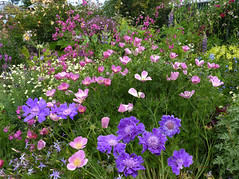
"Baby Blue Eyes" ,Dianthus carthusianorum, Eschscholzia ccaespitosa Aquilegia 'Krystal' Lupinus & 'Rodeo Rose'

This garden owes its charm to annuals like wee Eschscholzia caepitosa, Lupinus succulentus 'Rodeo Rose' and Nicotiana alata 'Lime Green.'

So when Fine Gardening asked us if we wanted to write a story about our Top 10 Favorite Annuals, how could we say no? Of course we’re not talking boinky, squatty, run-of-the-mill annuals you can buy in giant stores which shall remain nameless. We mean old-fashioned, hard-working, classic cottage garden annuals that exude charm and pull the garden together. They bring in the bees and hummingbirds and hide the knobby knees of taller perennials, thrilling us with their sparkle and shine. In other words, they’re the annuals we can’t live without!

Our Spring gardens would be incomplete without CA native Nemophila menziesii "Baby Blue Eyes."

Renowned for their profuse bloom, delightful habit and conveniently self-sowing ways, these original varieties are almost impossible to find in many nurseries nowadays. You’ll most likely have to start them from seed unless you order them through our mailorder department or can find small plants offered at local farmer’s markets or plant sales.

It's Polygonum mania!

Thomas Jefferson grew Polygonum orientale at Monticello and it was first grown in the US in the 1700s.

Of course, annuals are also a little misunderstood. Some people want to know why they should bother planting something “that’s just going to die.” Welllll, we have lots of opinions about that! The annuals we’re talking about don’t just disappear after one season. They’re tried and true, seeding themselves here and there, so you’ll have plenty of FREE plants next year. After hundreds of years of being passed-along and shared, they’re classic cottage annuals for a reason!

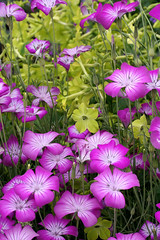
Viscaria oculata "German Catchfly"

"German Catchfly" blooms like crazy and is one of the most cheerful sights in the Summer garden.

Gah! Spring!!

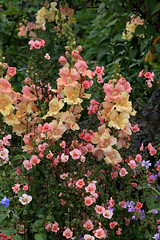
Lime-a-licious Nicotiana alata 'Lime Green' combines beautifully with just about anything.

While a massive amount of trendy plants and the latest hybrids come and go each year, old-fashioned favorites like “Love–in–a–Mist,” “Bachelor’s Buttons” and “Kiss–Me–Over–the–Garden–Gate” soldier on in cottage plantings across the globe, appreciated for their resiliency and treasured for the ethereal charm they bring to our gardens. We’re so happy we have a chance to share them with you. Pick up a copy of the March/April issue of Fine Gardening Magazine to get the whole scoop!

Bloomin’ Bloom Day

15 Feb

All that gorgeous 80-degree weather that we were, um, NOT gloating about last week, has turned to lovely, lovely rain, which is exactly what the gardens need right now. One of the stand-up, stand-out bloomers pretty much year-round here in USDA zone 9-10 is Aristea inequalis.

Aristea inequalis

This incredibly tough South African Iris relative is planted in a 12″ parking strip in front of Annie’s house. There’s nice soil for maybe about 4″ and then it hits hardpan. In the rainy season, there’s a culvert up the street that often overflows, sending a river of water right past this guy and eroding all of the soil around it. Does it care? It does not.

Aristea inequalis in parking strip

In fact, each year it seems to get bloomier and bloomier, with a tidy 3′ x 3′ foliage clump that never needs cutting back. It’s the plant we most recommend to beginning gardeners because it’s virtually indestructable! Bonus points for being hardy to USDA zone 8 and clay, heat and drought tolerant! Oh, AND deer resistant!

Aristea inequalis habit

Thank you Aristea inequalis! And thank you to Carol at May Dreams Gardens for hosting Garden Bloggers Bloom Day! See what’s blooming on other folks’ gardens this February!

In the Garden

9 Feb

The sun is shining and the birds are singing! Even though much of the country is still blanketed under snow and ice (brrrrr!), we’re pretty lucky here in USDA zone 10 to be able to  garden year-round (not that we’re gloating or anything).

mannequin bed

Each year, Annie completely replants our demonstration gardens to keep things fresh and exciting. It’s dramatic to see everything ripped out and a new garden taking shape from scratch, but new designs and combinations provide inspiration for both us and our visitors!

planting

Back in November, she turned over the soil, took out the spent annuals and cut the perennials down to the ground. She ditched the ugly plants, the unruly plants and anything that didn’t fit with the new planting scheme taking shape in her head. This made room for lots of new babies. The goal – and challenge! – is to have everything bloom at the same time for our Big, FAB Spring Party on April 9 and 10.

baby plants

November is also when she planted biennials like Digitalis and some varieties of Verbascums and Campanulas, along with perennials like Alonsoa meridionalis, Delphiniums and Nicotiana alata ‘Lime Green.’ Of course, all of these plants can go in the ground right now for May or June bloom!

baby plants1

Right now, if you were to drop into the nursery, you would find her still planting a few perennials, as well as slower growing annuals like Orlaya grandiflora, Agrostemma githago, Omphalodes linifolia and Cynoglossum amabile. It’s also a good time to put in foliage plants like Heucheras, Rumex and grasses. We planted a few Sweet Peas in November and will plant some again soon, so we’ll have a succession of frilly, fragrant blooms from April to June – longer with deadheading!

planting

Very soon, the faster blooming annuals like Poppies and California native “Baby Blue Eyes” and Eschscholzias (Cal Poppies) will go in the ground – but remember – we’re shooting for early April bloom. So you can definitely plant them right now or anytime really until the end of March or beginning or April for later bloom.

Don’t forget to protect your little babies from slugs and snails! We use Sluggo, a non-toxic iron-phosphate based bait that is safe for pets and kids. Snails are ravenous and they’ll chow down on those delicious little CA natives until they are but stubs in the ground. You won’t be very happy if that happens – and neither will the plants.

lunaria_rosemary_verey

Even though the goal is to have everything bloom-at-the-same-time, sometimes the weather doesn’t get the memo. A cold and rainy Winter will slow everything down, while sunny weather in December and January can result in a massive bloom-a-thon in March. So we aim for the middle and hope for the best. And it usually works out pretty well!

spring is coming!

Poop, Glorious Poop

3 Nov
The happy cows of Point Reyes
The Happy Cows of Pt. Reyes. Don’t they look smug.
A couple weeks ago, we took a much needed field trip up north to Point Reyes to visit the hilarious and cheesy Point Reyes Compost Company. Did we say cheesy? Yes. And we meant cheesy. Because in addition to high quality, super classy poop, the family also makes cheese. Aaaaahmazing cheese. The compost is awesome, too, and of course we carry it, because it is both quality and hilarity mixed into one fine bag of crap. (Their tagline? “Our products are mostly crap.”) 

Doubly Doody & pretty pumpkins
The Point Reyes Compost Company is married to the Point Reyes Farmstead Cheese Company. Literally! Teddy, big man on poop campus, and our hilarious guide for the day’s tour, is the son in law of Bob, who’s the big cheese of the family. Allow yourself a little bit of mental gymnastics to appreciate both things simultaneously. Fabulous compost and insanely good cheese, all from the same herd of well cared for and pampered cows. We think it’s a fine recipe for sustainability.
Teddy giving us the inside tour
Teddy giving us the inside tour.
The milking barn
The Milking Barn. Can you tell how clean this place is? In case you can’t, I’ll just tell you: it’s super clean.
So when the company invited us up to peruse the grounds and meet the cows AND try their various cheeses, of course we said YES PLEASE! Have you had their blue cheese? It’s more than a little amazing. I have to say, we ate our share during our visit. Blue Cheese hangover? Not so pretty, but so worth it.
Macaroni & Cheeeeeese
Macaroni & Cheeeeeese. With bacon.
This small company has taken steps to close the loop of waste in inventive but common sense ways, from input to output. The cows are maintained on a diet largely consisting of materials that are the (edible!) byproduct of other consumer industries, and on the other end, the post-cow waste is lovingly handled in small batches to ensure that the crap that you take home is High. Quality. Crap. Plus, who doesn’t love any company that has a methane digester on the property that can, at peak, provide 85% of the power required to keep everything running?
moo food
A sampling of the bovine diet.


poo pile
This is 2 days worth! Holy crap!

We came away from the day with the warm impression that this family really cares about the impact they are making on the environment (and on beautiful Point Reyes!), the care they take with their cows (their cow’s health care program is largely based on preventative services – big YAY!) and about creating an efficient and primarily closed system where the waste produced goes to good use – in our home gardens and yours! We also went home with a taste for their blue cheese that may sour us on any other ever again. Sigh. Life is so hard.

bebe cow!
Bebe Cow!


Red winged black birds!
Red Winged Blackbirds. Droves of them – so pretty and so noisy.


es-ca-pay!
While we were distracted by the CHEESE, a baby cow escaped from the baby cow village and
started “maintaining” the landscape.

Point Reyes is perrrrty
If I were a cow, I’d be pretty stoked to hang out here.
Baby cow cottages
Baby cow cottages. Don’t worry, they have room to move around.
Equipment!
This is what they use to turn the compost. Serious stuff!
Hot shit!
It’s important to make sure your poo is well cooked
to destroy harmful pathogens!

Our First Garden Bloggers Bloom Day!

15 Oct
Here in the Bay Area, October is when we finally get a taste of Summer. The long days of overcast mornings and cool but sunny afternoons finally heat up and our Indian Summer begins. Right now, I’m thrilled about two super long-blooming low maintenance plants which reside in mutual affection here in a back corner of the nursery. 

Hibiscus cisplatinus

Hibiscus cisplatinus
Since so few gardeners know of this amazing Hibiscus, I am probably its number one fan in all the world! (and honestly, I think our staff is a little bit worried about this). Handy-dandy for filling in a large space, it will grow into a dense evergreen base-branching shrub 5’ x 5’ in its first year. Never showing signs of chlorosis like many tropical species here in the fogbelt, it is most vigorous *and* bloomiferous – bearing huge cotton candy pink flowers from May to December. Prominent and velvety cherry-colored stamens emerging from a rich ruby throat take its beauty ratio to a whole ’nother level! In Winter, I cut it down almost to the ground and each Spring it has bounced back bigger and better than ever.

Hibiscus cisplatinus habit
Echium gentianoides

Echium gentianoides spike

The perennial rebel of its family, Echium gentianoides blooms almost year around here in coastal California. Notoriously difficult to photograph, all who see its large bright blue flower spikes, fine form and complimentary smooth blue-grey foliage in person fall in love and take one home. Luckily, it’s easy and fast, reaching a manageable 4’ x 4’ within a year.

Echium gentianoides habit
Thank you to Carol at May Dreams Gardens for hosting Garden Bloggers Bloom Day! It’s a lovely honor to participate.


The Great Honking Smokin’ Hot Gargantuan Poker Plant of Annie’s Blooms Again!

2 Oct


Kniphofia multiflora showed up at the nursery a few years ago, as a solitary seedling, alone in its tray. Not very promising for propagatability, but a plant with this magnitude of awesomeness? Sometimes one MASSIVE POKER PLANT is enough! We were pretty thrilled with our crop of one, feeble though it was. Our wee seedling spent a few months in the back of the greenhouse, and then was transferred to larger quarters where it began to grow… and GROW… AND GROW! Last October it sent up its first flower spike for our Big Fall Party (Timing plus! Sweet of it to mark the occasion, don’t you think?) and acquired many new admirers. Now again, just in time for our big event, our glorious mama plant is putting on another big show!


Jen, for scale

The plant has doubled in size since last fall, and added a few spikes to its floral display. If the amount of growth it’s put on this year is any indication, next year we might have to throw IT a party. It’s getting to be one of the most awe inspiring specimens in the nursery.
Up Up Up!
Lucky us (and lucky you!) we pulled off a small crop this year! There are a modest sum of plants available to mail order folks, and some larger specimens for sale at the nursery – IN BUD!! Too big to ship and a good reason to get into the nursery early this weekend if you’re able. They’re crowded around our original specimen, looking oddly like mini-monster babies of the big mama in the huge pot.
Kniphofia multiflora friends
Though this species is from wetlands, ours has thrived with average water in a (HEEUGE) pot of good soil. We top dress with compost once a year when the plant is in growth (it goes deciduous in Winter, which I fretted over the first season for no good reason – it grew like mad once warm weather returned) and try to keep it out of the way of excessively harsh weather.

September in Our Gardens

24 Sep
Fall Gardens

Well, here’s my first go at a blog!

I will try not to write too much as I am pretty chatty when it comes to gardens, but hey, isn’t this pretty! As you can see, I have packed in a bunch of plants and I think gardens look good that way. I love cottage gardens and I love them full of life. This shot is taken of one of the widest beds at our nursery – it’s maybe 8’ deep. To pull off a showy Fall garden like this, you have to plant quite a bit ahead of time, well except for the annuals like that gorgeous rosey-violet “Corncockle” – Agrostemma githago ‘Milas.’ Here’s a close up:
Agrostemma githago 'Milas'
I planted that about 6 weeks ago in early August. I was frantically planting late as the weather was so cool this Summer and my Spring plantings didn’t fade till mid Summer. Then we were hit with several days above 100°F and I think I lost one of the “Corncockles.” There a few more squished in there somewhere that should bloom in time for our Fall Party in early October – so all is well. To the left of the “Corncockle” is a ‘Golden Celebration’ Rose and Aster ‘Skyscraper.’

'Golden Celebration' Rose & Aster 'Skyscraper'


I’m very happy with ‘Golden Celebration.’ She blooms Spring thru Fall with no mildew or disease here in fog-landia. And she’s a nice size 4’-5’ tall, much more manageable than ‘Graham Thomas.’ I bought her at Berkeley Hort nursery 2 years ago and she has definitely passed the test and is very popular with our staff. And I think I have found her a fine partner with this Aster. It’s an excellent one with large blooms for 2-3 months or more (with dead-heading) and a good color, not too pale as others can be. It’s a good strong perennial, coming back bigger and bushier each year. Normally, ‘Skyscraper’ grows to 4’ or 5’ tall, but as I got it in late (August), it’s blooming here at only about 3’ (I think I pinched it, too, to help it bush out faster).

And there’s another annual – bushy ‘Italian White’ Sunflower just starting to bloom behind ‘Golden Celebration.’ I love how we can plant Sunflowers so late along the CA coast and have them in bloom for September and October. They just bring so much fun to a garden, don’t you think?

Behind the Sunflowers are red Dahlia coccineas coming on. Now that the huge Spring-blooming New Zealand Delphiniums have been cut back, there is space for them to grow.

Dahlia cocinnia
They give the garden its “spark,” along with the red ‘Altissimo’ Rose against the sky in the background. A lot of times a garden needs a “pop” of red or orange amongst all those soothing colors to make it come alive. Those pink fluffs in the background is the totally awesome ‘Grandmother’s Hat’ Rose. If you like Roses you must grow ‘Grandmother’s Hat!’


Rosa 'Grandmother's Hat' in full bloom 

Rosa 'Grandmother's Hat'
Another ever-blooming Rose with gorgeous girlified old-fashioned flowers and a absolutely heavenly scent. What’s more, it’s completely disease resistant in our gardens. You just can’t go wrong with her. In fact, some mean person once jumped over our fence and dug her right out of the ground the night before Mother’s Day – I’m pretty sure to sell the cut flowers – and I cried and cried. But she came back from a piece of the root left in the soil just as fabulous as before. That’s a tough girl! Yay!

Behind ‘Grandmother’s Hat’ is a super cool, tall background perennial that we don’t offer at the nursery anymore since no one ever bought it. It’s old-fashioned “Joe-Pye-Weed” or Eupatorium purpureum.
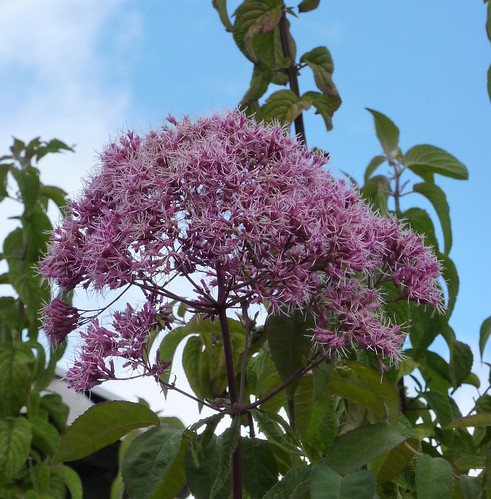
You’ve probably heard of it, but when was the last time you’ve seen it around? Maybe you East Coast folks can chime in, but I rarely see it out here in California. It is one valiant, long-lived perennial and I don’t think you could possibly kill it except maybe to douse it with poison or never give it any water. It’s fairly drought tolerant, heat and deer proof and returns faithfully each Summer – even when you forget all about it (like me) as it’s deciduous. I’m sure I’ve chopped its roots terribly in late Winter when I turn over the soil during clean up chores but it never seems to resent it. It’s just happy no matter what! It’ll grow 5’-8’ tall depending on crowding and makes a makes a loveable vertical background much adored by butterflies. The 6” flower clusters are sweetly scented of vanilla, too! You can find seed for it online -one company I like a lot is Easyliving Native Perennial Wildflowers.

In the background towards the right you can sorta see what looks like light yellow pom-poms. That’s one of my all time favorite (and cottagey) perennials Scabiosa ochroleuca. It’s major bloom for the buck, blooming Spring thru Fall pretty much non-stop (but of course you should deadhead it).
Scabiosa ochroleuca

Scabiosa ochroleuca closer upper
From the Mediterranean, it’s drought and deer resistant and just loves to grow on the edge of the bed where its roots appreciate the extra drainage. Its soft yellow color goes so well with blues and pinks and its stems bounce around in the breeze. If you grow it in your garden make sure you cut it back to the base in Winter so it looks fresh and clean when it bushes back out in Spring.

Those vertical white spikey things see you poking up here and there are another favorite perennial of mine – Verbascum chiaxii ‘Album.’
Verbascum chiaxii 'Album' in the garden

Pretty Verbascum chiaxii 'Album'
Actually, I didn’t plant them. They are all self sown volunteers – and, oh – I do love my volunteers! Really, no cottage garden should ever be without this Verbascum (common name: Mullein). Tough and simple, they are truly plant and forget. All I ever do is cut the spent flower spikes to the base and within a month, there’s another one springing up. Not fussy about soil, they’re adaptable to sun or bright shade, are drought and deer resistant and they self-sow so you’ll never have to buy a second one. You just get to enjoy the cool and smart places they appear in your garden, like that non-blooming one growing out of the rocks (yep, they’re that tough) right up front.

Speaking of volunteers, that’s an Agastache with the apricot flowers also growing out of the rocks up front. I think it’s ‘Apricot Sprite’ or probably ‘Coronado’ (which I like better).

The emerald green blobs to the right of the Agrostemma are very late blooming Aster oblongifolius. So late, they aren’t blooming yet. I really planted them too late. Usually, they start blooming in August and go thru September or October but here they probably won’t start blooming till October, when a cloud of lavender blooms will smother the foliage. Nice and dense of form, I thought they remained rather short but recently saw some extremely robust ones in a Santa Cruz garden that were 3’ tall. If you’ve got crummy, dry or clay soil, this native of the Midwestern prairies is so sturdy, it will thrive in it. And don’t worry when it goes deciduous in Winter.
Aster oblongifolius
I also have some Dianthus plumarius up front (with the bluish grassy foliage). They would be so pretty and blooming right now except that we’ve hacked at them severely to take cuttings so we can offer them as named varieties next year. We normally grow these “Old Fashioned Pinks” from seed and their colors are variable – but these particular seedlings were so lovely, we wanted to preserve them for other gardeners. We can only do that by taking cuttings. Here’s what they would look like if we hadn’t mauled them.
More Dianthus love

Our new Dianthus
I can certainly go on and on about these old school Dianthuses – but I will save that for another rant. Wait, here’s a quick peek at how they looked in the same garden in July.
Rose & Dianthus bed
In the first photo above, you can see Columbine (below the Agrostemma) waiting for Spring to bloom again. It’s Aquilegia ‘Blue Barlow,’ which looks contrastingly fab against the ‘Golden Celebration’ Rose. It’s just a little reminder to plant your Columbines in Fall if you want them to get big, bushy and truly bloomiferous come Spring. Remember, you want to plant your perennials ahead of the season that they are supposed to bloom.
Oops, I forgot the dark foliaged mounds. Most of you will know they are Heucheras and I know for sure that the one on the right is ‘Melting Fire’ – my current favorite red one. As much as I love masses of flowers in my gardens, I’ve come to really appreciate pretty leaves, foliar contrast and as they say “a place for the eye to rest.” Heucheras fill the bill are easy and long lived and then, well, they look extra lovely when they go into bloom in Spring!

~Annie

Hello world!

17 May

Welcome to WordPress.com. This is your first post. Edit or delete it and start blogging!

Fantastical and Majestic Giant Dahlias!

6 May

We Bay Area folks are blessed by the Dahlia Deities, for we not only get to grow these magnificent towers of flower, they grow here LIKE WEEDS (Have no fear, they are not invasive and do not self-sow). Those of us who grow these in our own gardens, and especially those who have plants that are visible from the street, know it is the kind of plant to draw a crowd. Passersby get a bad case of rubberneck, drivers park suddenly and hop out of their cars with cameras. It is not unheard of for total strangers to knock on your door to enquire with awe, What IS that thing?

Dahlia imperialis
It is Dahlia imperialis, people, and it is a whole lotta Dahlia! To at least 8 ft. tall, it can reach 20 ft. when happy. In areas with cold Winters, some gardeners include this monstrous beauty just for its foliage! The tall canes are bamboo like, with lush leaves. The flowers, though, the flowers!! Each lavender pink bloom can span up to 6” and the massive flowering panicles can be 3 ft. across – and mind you that is per stalk! Large plants can produce an abundance of flowers both alarming and astounding when you stand underneath them in full bloom and see them allll looking down at you. Wonder!

Dahlia 'Double White'

Dahlia tenuicaulis

We grow TWO forms of Dahlia imperialis – the single pink form, and a fantastical double white flowering form that has all the same requirements, but with stupendous double white flowers that look like shooting stars. Not only that, but occasionally – sorry guys, not right now! – we have another very special tree Dahlia species – Dahlia tenuicaulis, which blooms early and often with dark purple-magenta flowers. And we have a FOURTH top secret tree Dahlia in the works that I cannot talk about. Actually, forget I ever said anything. OOPS.