Earl Nickel,
The Curious Plantsman
As spring approaches summer, many a gardener begins thinking about summer blooming plants like flowering maples (Abutilon), Yarrows (Achillea), Snapdragons (Antirrhinum), Carnations (Dianthus) and Dahlias. This is however a great time to plant summer-blooming vines too. Vines, as a group, are generally one of the easiest plants to grow.
They are incredibly versatile, with their ability to climb or spread along a variety of surfaces (arbors, trellises, fences), and they produce an abundance of flowers, everything from the small, pure white and sweetly fragrant flowers of Sweet Autumn Clematis (C. paniculata) to the colorful and exotic Sea Anemone Passion Flower (Passiflora actinia).
There literally is a vine for every purpose (for showy effect, to cover a problem area, to attract pollinators, even to produce edible fruit) plus a dazzling range of colors for the flowers. Annie’s sells a great variety of vines, including several that can be kept to a more modest spread (Asarina, Mexican Love Vine (Mina lobata) and Moonflower morning glory (Ipomoea alba ‘Moonflower’) to name a few.
Showy Vines
While most ornamental vines have attractive flowers, I have reserved a few of today’s selections for the sections on Vines for Problem Areas and Vines for Smaller Spaces.
Clematis.
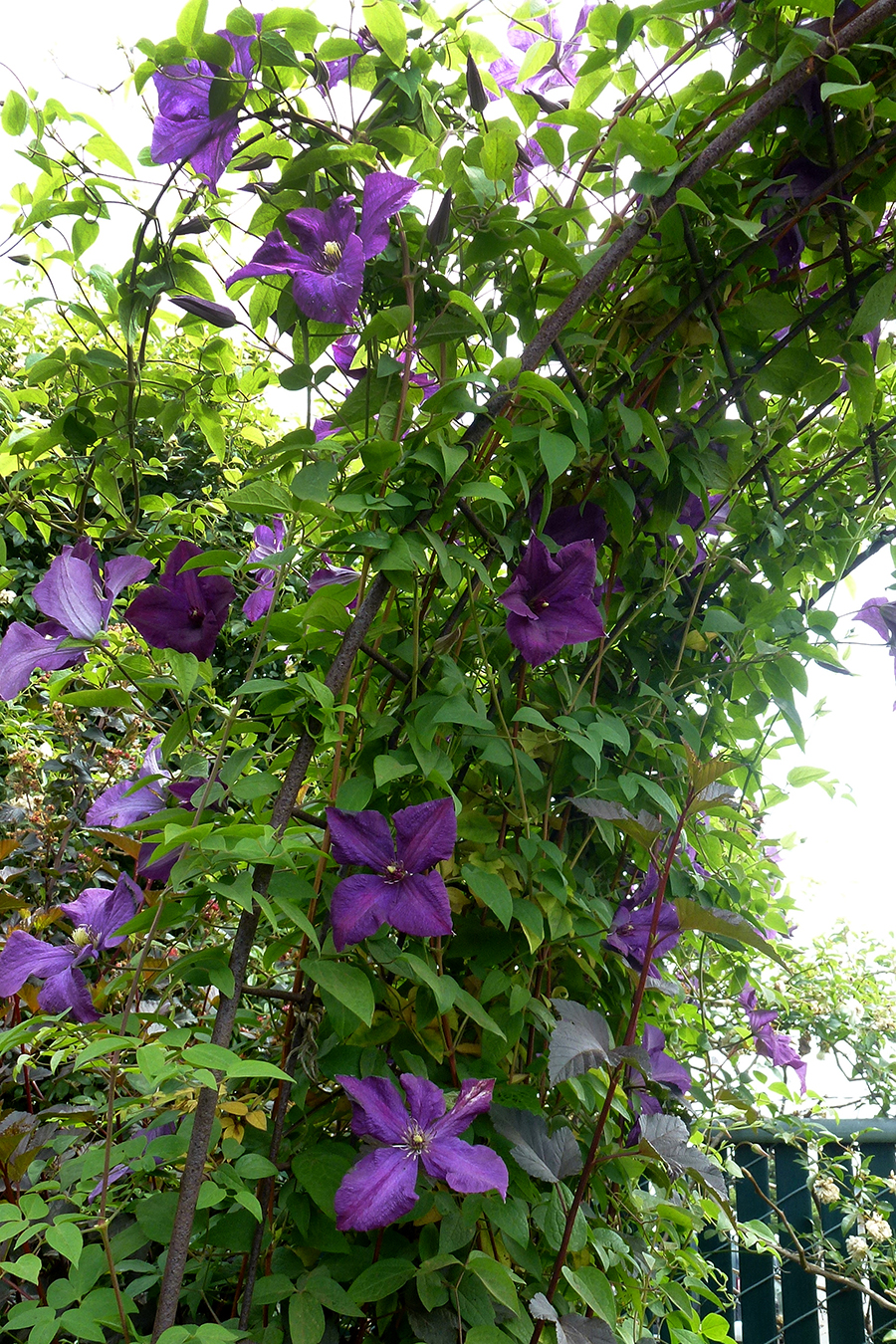
Clematis flowers are among the showiest – and perhaps surprisingly to some the most diverse in color and form – of all the ornamental vines. In hot climates, they want relief from midday sun while in more temperate regions, such as here in the Bay Area, they want a good amount of sun. Apart from the differences in their flowers, clematis species or varieties divide themselves into being deciduous (most of them) or evergreen.
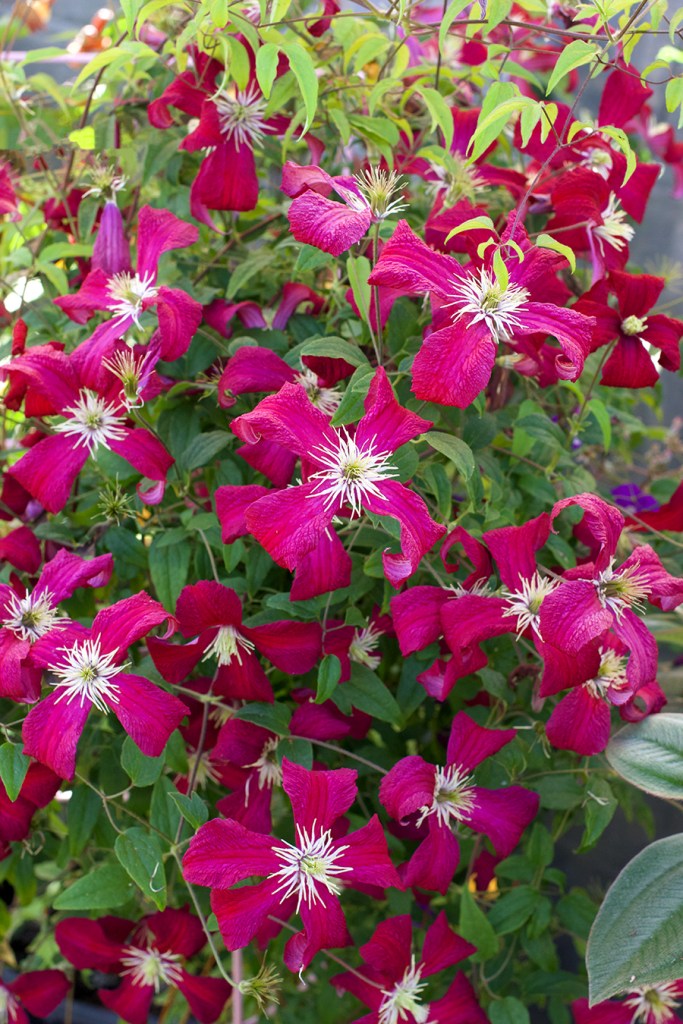
Four of the showiest large-flowering varieties offered at Annie’s are the burgundy ‘Etoile Violette’, the lavender ‘H.F. Young’, the blood red ‘Madame Julia Correvon‘ and the deep purple ‘Polish Spirit.’ These outstanding performers have been in the nursery trade for many years, proving their durability, disease resistance and versatility. ‘Etoile Violette’ features large, splayed 3” long petals of vivid burgundy, offset with mesmerizing cream-colored stamens. It blooms mid-summer, with a second entrancing performance in fall.

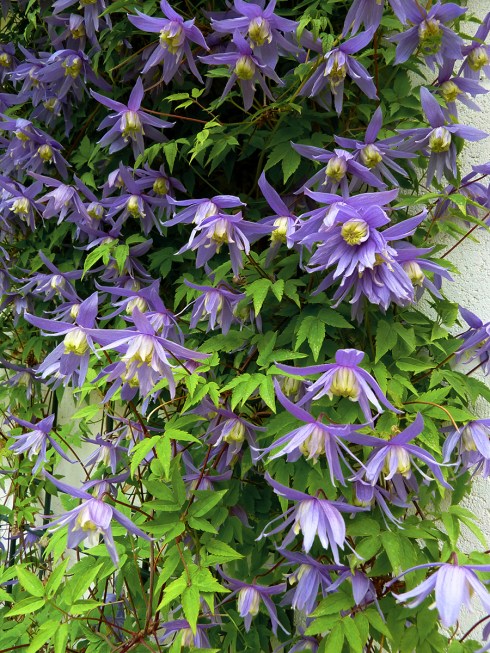
‘HF Young‘ has one of the largest flowers in the clematis kingdom, each rich lavender bloom an eye-popping 7” in diameter! A prolific bloomer starting in mid-summer it, like many clematis, attracts a variety of butterflies and hummingbirds to its flowers.
Where this beauty offers a pastel palette, ‘Madame Correvon’ displays the richest wine-red blooms. A bit smaller and with just 4 petals, it nonetheless is the ultimate focal point in almost any garden. This deciduous, group 3 variety blooms on new growth, so prune to about 1’ tall in early spring for an even more impressive display the following year!

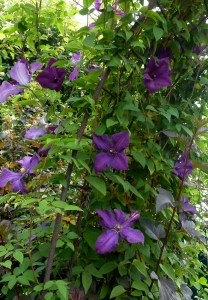
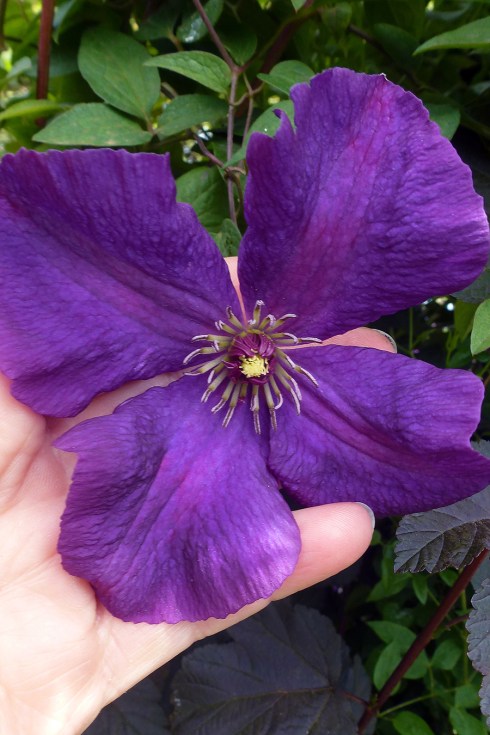
Clematis ‘Polish Spirit’ might be considered a sister to ‘Madame Correvon’, given its saturated purple flowers displayed on 4” petals, and it being a group 3 selection, so choosing one or the other may simply be – do you like dark red or vivid purple better?
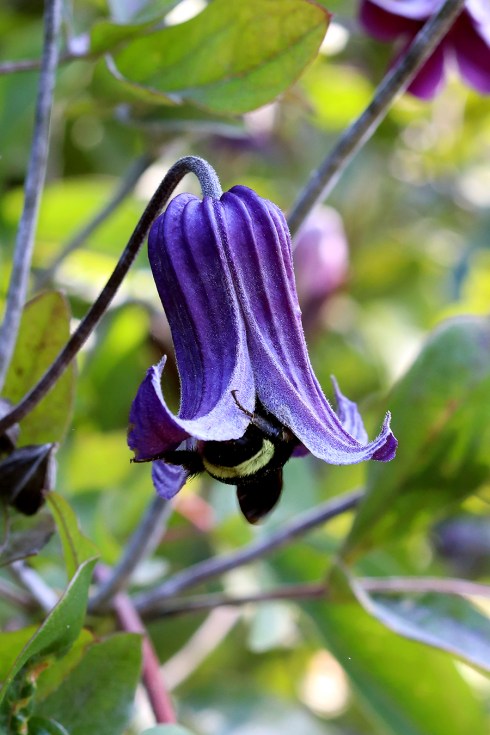
Two other clematis are worth investigating. Sweet Autumn clematis (C. paniculata) is smothered in small white fragrant flowers in the late summer while the intriguing C. ‘Rooguchi’, the easiest to grow and longest blooming clematis out there, is cherished for its totally cute 2” flaring purple bells. Borne in crazy profusion from late spring to early fall, these white-throated, stiff, nodding flowers arch out on showy black stems.

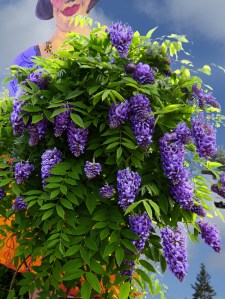
You may think you know Wisteria, most of which hail from China or Japan, but let me introduce you to an American beauty – W. ‘Amethyst Falls.’ A fantastic small-scale variety, this American wisteria tops out at only 15-20’ and 6’ across (if left unpruned). Ours is growing in a barrel and kept to 6’ tall, indicating that this showy bloomer is perfect as a stunning patio plant. Blooming bountifully in spring and intermittently in summer, its beautiful, richly colored blue-purple pinecone shaped 4-6” dense pendulous clusters are lightly fragrant. It likes sun so make sure to give it lots of light.
Want something showy and unique in a hurry? Cape Sweet Pea (Dipogon lignosus) is one of the fastest growing vines in the trade. This South African legume will reach 10’ in 2 to 3 months and bloom spring through fall!
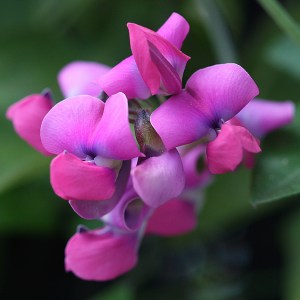
Held on arching stems, the grape soda-scented pink & red flower clusters really pop against lush green, heart-shaped leaves. Despite its romantic appearance, it is perfect for covering a fence or smothering an arbor. Rich soil and full sun yields the best show but part sun will do. It may go deciduous during heavy frosts. Self-sows!

If pink and more pink is your thing, Pandorea jasminoides ‘Pink Supreme’ might be your cup of tea. Fast growing, green and glossy foliage provides the perfect backdrop for a multitude of lovely, 2” flared trumpet, soft pink blooms, each highlighted with a bright cherry throat. Smelling lightly of jasmine, this wonderful 10-15′ tall selection blooms continuously late spring to fall, peaking in mid-summer. Attracts hummers, too! Plant this evergreen vine in rich garden soil and sun/light shade and watch it easily cover a fence in a few seasons.
Vines for Screening or Problem Areas
One of the most popular uses for a vine is to provide screening or to cover a problem area. You are looking for a vine that fills in fairly densely and typically one that does so quickly. Annie’s has four lovely vines that are perfect for either use. Most notably are 3 varieties of passion vine (Passiflora species).
P. loefgrenii x caerulea is a mouthful but it produces a thicket of verdant green leaves then come late summer, beautiful purple flowers. This rare vine features reflexed 4” petals, putting the spotlight on the halo of deep purple fringe and the black center. The Gulf Fritillary butterfly thinks they’re pretty fab too, choosing this fast-growing vine as a host plant.

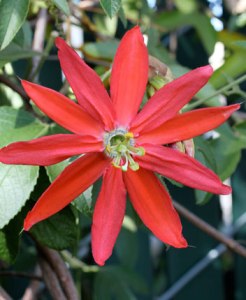
Passiflora ‘Oaklandii’ is another cross that does a great job blanketing a fence or trellis. I grew it in my yard, where it flourished with almost no care. It sports huge coral-red flowers that, en masse, look like brightly colored starfish. This evergreen vine is so dazzling when in bloom, you might in fact want to put it front and center in your garden.
That would be especially true for Sea Anemone Passion Flower (Passiflora actinia). Sporting a halo of psychedelic wavy purple fringes, this frost tender passion flower is sure to elicit cries of “What is that?!” It grows quickly, produces legions of 3” purple flowers and attracts many a butterfly to its flowers. Prefers sun but can handle a bit of shade.

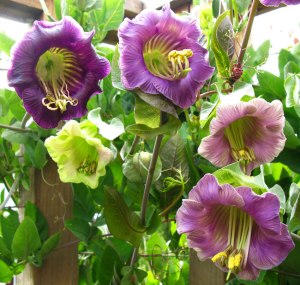
Cup & Saucer Vine (Cobaea scandens) does a similarly fabulous job of blanketing an area in dense foliage. Then, come summer, it produces Alice-in-Wonderland-like flowers – each green flower looking exactly like a cup and saucer.
But wait, for its piece de resistance, those green flowers suddenly turn a yummy purple hue. Magic! Very vigorous and needing very little water once established. Many of you will be familiar with the popular orange Black-Eyed Susan vine (Thunbergia alata) but did you know that Annie’s carries 3 other varieties of this vigorous vine? There’s the lovely oh-so-pink ‘Rose Sensation’, the reddish-orange flowering ‘Amber Stripes’ and the evocative ‘White Halo’, with its pure white petals anchored by a bullet black center. All three share the virtues of this vine – fast to establish, early to flower and long blooming and very drought tolerant once established. They prefer sun.
And just for fun, how about turning farmer and growing a grape? Annie’s offers two varieties. Vitis ‘Emeryville Pink’ is an American type grape, first found growing by the Bay in Emeryville. We’ve grown it successfully for years and it has become a beloved seasonal snack for visitors and employees alike! It grows 6-8’ its first year and then takes off in year two, giving you plenty to harvest.


Or if the fruit isn’t as important, how about the blazing red-leaved Vitis californica x vinifera ‘Roger’s Red’? The fruit is a bit seedier but is beloved by local birds and wildlife. Or you can make jam with the fruit. Large heart-shaped leaves are a soft grayish-green in summer but then turn a riotous red in fall, putting on a spectacular show. Both varieties prefer sun and are very drought tolerant once established.
Vines for Smaller Spaces
Sometimes you have an area where a rambunctious vine would simply get too big. Fortunately, there are several attractive vines that don’t get too big.
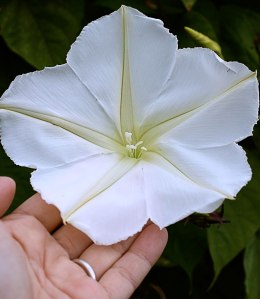
Begin with the Moonflower morning glory (Ipomoea alba ‘Moonflower’). Enormous (6”) white blooms, deliciously fragrant, open in the evening and close before mid-day. Luxurious heart-shaped leaves densely clothe this vine, which can grow to 12′ but can easily be kept to 6-8′ tall. A wonderful vine to plant near an outdoor patio or near one’s bedroom window, where one can imbibe the early-summer-through-fall blooms.
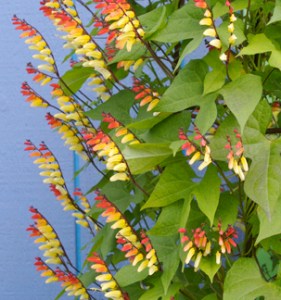
One of my favorite small vines is the quixotic Exotic Love Vine (Mina lobata). It produces delicate but bushy green leaves and then come summer, slender vines that sprout rows of small tubular flowers. Each inch long flower starts out bright red then, as the flower gets bigger the color ages to orange, yellow and finally white. With a long row of flowers on each blooming vine, one gets treated to every color on this spectrum at the same time! This petite vine is perfect for growing on a deck trellis or up a corner column. It loves the sun.
And finally, let me introduce you to the delicate and lovely Snapdragon vine (Asarina scandens ‘Joan Lorraine‘).
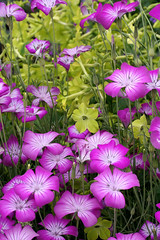
This beautiful Mexican vine with white-throated, velvety purple trumpets and lush delicate foliage creates a lush 8-10’ high “wall” of trident-shaped emerald green leaves. It’s a long bloomer too, filling the summer and fall skies with masses of the richest 2” flaring purple blooms. Attracts hummers! Best in part shade to morning sun and rich soil. It can be cut back in fall.

A Vine for Every Purpose
Whether you want a vine for beauty, to serve some practical purpose or to attract pollinators in your garden, there is an attractive vine for nearly every situation. The hardest task may be choosing just one!
Availability
Just so everyone knows, some of the Annie’s Annuals plants mentioned here might not be available on the week that you’re reading this blog article. Some of the plant varieties discussed are only available in our retail nursery in Richmond CA. This is generally due to us only being able to grow small crops or the fact that the particular plant does not ship well. A quick look at that plant’s page will let you know if it’s available. If not, just click the Add to Wishlist button and we’ll notify you when that plant is ready to take home.








 blog.anniesannuals.com