Tag Archives: garden

The Joy Of Planting Fall Bulbs!

4 Oct

Ahh, the joy of planting fall bulbs! It’s one of the most exciting times for us at The Starter Farm in Santa Ynez, California. We plant thousands of bulbs, tubers and corms each fall and wait with baited breath for the explosion of color that will burst forth, like a floral firework display, in late winter through early spring. Here at the farm, most of our bulbs and corms go into long beds to be cut for our favorite customers, however, we can’t resist tucking a few into our own gardens to enjoy their full spring display. The bulbs on offer, if left to die back naturally, will return year after year to give a lifetime of color that signals the beginning of the spring season. Some of your bulbs will even multiply, offering added delights that can be shared or spread around your garden in years ahead! This is dependent on your soil and climate, so read a head for more details. I am so excited to share with you, Annie’s 2023 collection of fall-planted bulbs that’s full of interesting, hard-to-find, new and classic varieties.

Narcissus

Let’s start with Narcissus! While commonly known as Daffodils, these varieties are not your common supermarket offerings. Narcissus are the workhorse of the spring garden and one of the earliest flowers to emerge from the ground.  As an added treat, many Narcissus are fragrant and provide the perfect perfume to cut and bring into your home.  Another wonderful quality of Narcissus is deer tend to avoid them. Now let’s talk about these varieties!
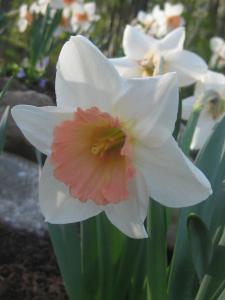
Pink Charm is a fantastic early blooming large-cupped white petaled daffodil that has the loveliest pink salmon inner cup that presents a unique color in the narcissus world.  Florists go crazy for them! 

If you want a similar variety that has even a softer hue, I would suggest British Gamble.  This girl is a bit taller with a frilly edge to her darkened cup with a lighter apricot hue inside.  For both selections, cooler weather will bring out darker colors.

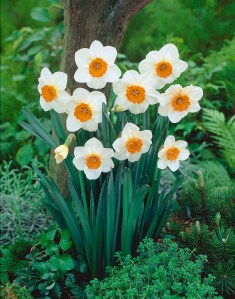
Barrett Browning is an old timey, small-cupped Narcissus. Large white petals with the most interesting red fringed cup that fades to orange at the center.  A bit shorter than other varieties offered here, it is an excellent naturalizer that comes back in force every year and excels in warmer climates.  At our farm we have relocated them to our gardens. Stem length is a bit shorter than we like for cut flowers, but those petit stems make her perfect for the front of beds or tucked under and in-between larger plants.

Replete is a must grow.  This double flowered daffodil is like a firework exploding with its ruffled petal display.  Huge flowers with creamy white outer petals and an explosion of soft orange to brighter tangelo inner petals emerge on mid-sized stems.  Some of our clients were surprised that these were daffodils!  Full, luscious, and always in demand, Replete is an unusual type that will bring you much happiness!

And now, some of my surprise favorite Narcissus.  I’ll confess, I was a little suspect of these multi-flowering varieties when I first started planting.  They looked different, I was not sure how long they would last when cut and they reminded me more of the common paperwhites you see around the winter holidays.  Boy was I wrong.  These fragrance monsters are stunners and extremely long lasting in the vase.  They fill a room with a lovely soft scent that is like fresh linen combined with strategic dabs of your favorite floral perfume.  When bunched, these flowers fill a bouquet that is perfect on its own.

Geranium appears like a soft cloud with perfect small orange cups that look like painted eyes peeping out over the garden.  It is like an artist’s rendition of what small daffodils should look like if they wanted a cool contrast between white and lovely orange.

Golden Echo is new to me. A slightly larger flower with one to three flowers. Rumored to be slightly less fragrant, we’ll forgive them that because I love the look of the bright yellow centers fading to a softer cream on the outer petals.  I’m thinking this will be an excellent selection to plant in masses.

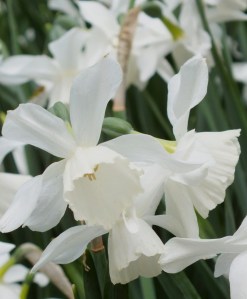
For years I had a mysterious single bunch of nameless, small-cupped, pure-white narcissus with curious petals growing near the house.  I was thrilled to unearth their name, Narcissus ‘Thalia’. I am now forever in love. A larger multi-flowered daffodil, the outer petals are unique with their elongated shape, pure white color, and power-packed fragrance.  Finding a good pure white narcissus is a challenge but Thalia is a unique variety that will return year after year and multiply fantastically!

Pro Notes for arranging with Daffodils! When cutting single cup varieties, we select stems that have buds which are fully colored, but slightly nodding (aptly called the ‘gooseneck’ stage) for the longest vase life.  Multi-stemmed varieties can be picked a bit closer to full bloom as they tend to have a longer vase life. When used as a cut flower, Narcissus can be a beautiful saboteur of her vase companions.  Once cut, Daffodils emit a sticky sap that will cause other flowers to wilt when arranged together.  You can easily thwart Narcissus’ aims by “bleeding” them out in their own water for a half hour until the sap stops and they can play nicely. You can then arrange them with other spring beauties if you do not recut them.

Ranunculus

Ranunculus are our most anticipated flowers for the season!  Ranunculus are often called spring’s peony, with their similarly shallow-cup-shaped flowers that spills forth layers and layers of petals, these blooms beat everyone to the garden and come in a multitude of colors.  Ranunculus make excellent cut flowers and should be picked once the buds start to color and are about to explode.  Most growers call this the “Marshmallow” stage. This will give you the longest possible vase life and flowers will continue to open after they’re cut.  The one exception would be the butterfly varieties. Cut stems when flowers are open.

For gardeners new to the world of fall planted bulbs and corms, Ranunculus are an excellent starting place. They should be shallowly planted at a depth of 1” to 2” in the garden or in containers. Make sure to avoid soils that may sit heavy and wet for long stretches through winter. They will sit dormant through the end of fall and into early winter. You should see green growth pushing in mid to late winter. This can vary depending on growing region and planting times.  In zones 9 and 10 bulbs can be left in well drained soils year to year. In colder climates and heavier soils, lift bulbs and overwinter indoors in a cool, dark space with low humidity.  If you think your ready to step up your Ranunculus game, I have some grower’s pro tips below.

The LeBelle varieties are the earliest fully petaled bloomers, so they’re a must for extending your season LaBelle Champagne is amazing for color.  It offers a selection of apricots, light rose, muted yellow and the very occasional hot pink.  It’s a great mix that provides soft and dreamy colors. The Amandine series is later to bloom and tolerates warmer weather. 

Amandine Scarlet is a vibrant replacement for that signature red rose and in some areas will bloom close to Valentine’s Day.  It is bold, brassy and a real stand out.

The Tecolote Series is wonderfully unique.  With fewer petals, its open face and prominent eye really pop.  Tecolote Salmon has that peachy/salmon color that florists and gardeners alike adore.  Like an inviting fairytale bursting with charm. The surprising green center to this flower adds to its whimsy and appeal

Tecolote Café is an absolute favorite with burnished red and deep terra cotta coloring just dripping with notes and tomes of coffee. 

Half Clone selections are their own animal…a strapping and beautiful animal. These Ranunculus are actually created through a process of combining tissue cultivation and seed production (some horticulture that is a bit above my pay grade).  What it gives us is selections that consistently produces robust plants with astonishing bloom rates.  The size of the flowers is impressive on solid stems prepared to do some heavy lifting.

Half Clone Iceberg will always be my go-to white ranunculus.  It is an outstanding plant with the most amazing pillowy white flowers.
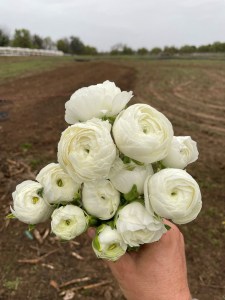
Half Clone Marshmallow is almost her twin but in a soft pink with a hint of green at its center.

Half Clone Juliette is a bolder pink, and perfect for any dreamhouse. 
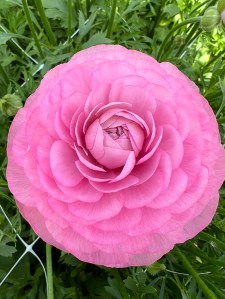
Half Clone Wedding Pastel was just released this year so I’m as eager to try her in the garden as you are, but from what I’ve seen these soft and glamorous wedding tones coupled with the strength and reliability we have come to rely on from this collection will be a flower to love forever.

Butterfly Ranunculus

Lastly the Butterfly Ranunculus. Oh, the butterflies.  Commercial growers for years have had access to these fantastic angels.  They are just now being offered to the general public and I personally am excited for you!  Unlike traditional ranunculus, Butterfly Ranunculus produce multiple flowers on a single branching stem that dances on the breeze.  A couple of stems will give you a full bouquet.  They add a lightness and air to our arrangements. Did I mention the colors?

Hades is a brilliant multi-petaled red that just screams red rose love.
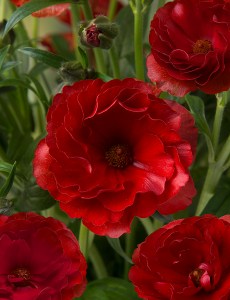
Musa a slightly duskier red that fades and softens like a pair of perfectly, well-worn jeans. 

Minoan is a single petaled orange that has this great contrasting darker eye that adds depth to the flower.

And now we have Thiva. This girl was just released to our farm this year.  I spied her at our client’s store and had to know her name.  I don’t know how she manages to be simultaneously muted yet a richly hued mauvy purple. I can’t wait to grow her myself!

Planting Ranunculus corms 1” to 2” deep in well drained soils will do any gardener just fine, but if you’re ready to do it like the pros, here are a few tips from the Starter Farm.  Ranunculus benefit from a process call pre-sprouting.  It is the act of hydrating corns and tubers in circulating water for about 6 hours before planting.  At the farm we tend to go shorten this for the Butterfly series as we want to make sure not to oversoak these larger roots and cause rot.  To help us circulate the water, we use a small water pump and some air stones (check out the fish section of your local pet store for everything you need).  We add a diluted compost tea as

we believe it enhances this process. A simpler way to do this is to leave them in a bucket under a barely dripping tap to cause movement and provide oxygen to the water.  You may find that using the drip method may add more plumping time to your process. You want the corms to double in size but not break apart. Once soaked we take the corms out of the water, allow them to drip dry and immediately plant them in soil that we amend with some good compost.  Once the plants are established, we fertilize with a good and balanced organic fertilizer as ranunculus are heavy feeders.  It is recommended you do this whole process just before your planting zone’s first expected frost date.  Ranunculus require cooler soil for strong root development. This pre-spouting process accomplishes two things.  One it gives you an earlier flowering time and two helps ensure that tubers are properly hydrated to give you the most robust possible growth. It is important to maintain consistent soil moisture during the first two weeks after planting while making sure not to overwater which will cause rot.

There is plenty of other growing information online for all of these varieties if you have further questions about spacing and growing conditions.  Happy growing and I hope you too share the joy we have with fall planted bulbs!

Mark Donofrio

Founder and Head Farmer at

The Starter Farm

www.thestarterfarm.com

_________________________________________

Mark Donofrio is a dear friend and an experienced flower farmer, growing a truly envy inducing assortment of flowers that he and his customers use to craft into fantastical bouquets. If you find yourself anywhere near Santa Ynez just a short drive from Santa Barbara on the Central Coast of California, pop into the areas many flower shops and locally owned grocery stores to see his fine craftsmanship in full display. Mark helped us to curate our selection of bulbs this year. He entertained and educated us in equal parts as he treated us to tales of growing, and his lists of bulbs that brought him endless delights as well as the occasional duds (we definitely skipped those). His enthusiasm and craft are an inspiration. To see more of his work visit his website www.thestarterfarm.com or pop onto his Instagram @thestarterfarm/

– Colleen W., Plant Maven

Summer Vines

15 Jun

Earl Nickel,
The Curious Plantsman

As spring approaches summer, many a gardener begins thinking about summer blooming plants like flowering maples (Abutilon), Yarrows (Achillea), Snapdragons (Antirrhinum), Carnations (Dianthus) and Dahlias. This is however a great time to plant summer-blooming vines too. Vines, as a group, are generally one of the easiest plants to grow.

They are incredibly versatile, with their ability to climb or spread along a variety of surfaces (arbors, trellises, fences), and they produce an abundance of flowers, everything from the small, pure white and sweetly fragrant flowers of Sweet Autumn Clematis (C. paniculata) to the colorful and exotic Sea Anemone Passion Flower (Passiflora actinia).

There literally is a vine for every purpose (for showy effect, to cover a problem area, to attract pollinators, even to produce edible fruit) plus a dazzling range of colors for the flowers. Annie’s sells a great variety of vines, including several that can be kept to a more modest spread (Asarina, Mexican Love Vine (Mina lobata) and Moonflower morning glory (Ipomoea alba ‘Moonflower’) to name a few.
Showy Vines

While most ornamental vines have attractive flowers, I have reserved a few of today’s selections for the sections on Vines for Problem Areas and Vines for Smaller Spaces.

Clematis.

Clematis flowers are among the showiest – and perhaps surprisingly to some the most diverse in color and form – of all the ornamental vines. In hot climates, they want relief from midday sun while in more temperate regions, such as here in the Bay Area, they want a good amount of sun. Apart from the differences in their flowers, clematis species or varieties divide themselves into being deciduous (most of them) or evergreen.

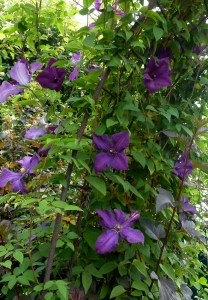
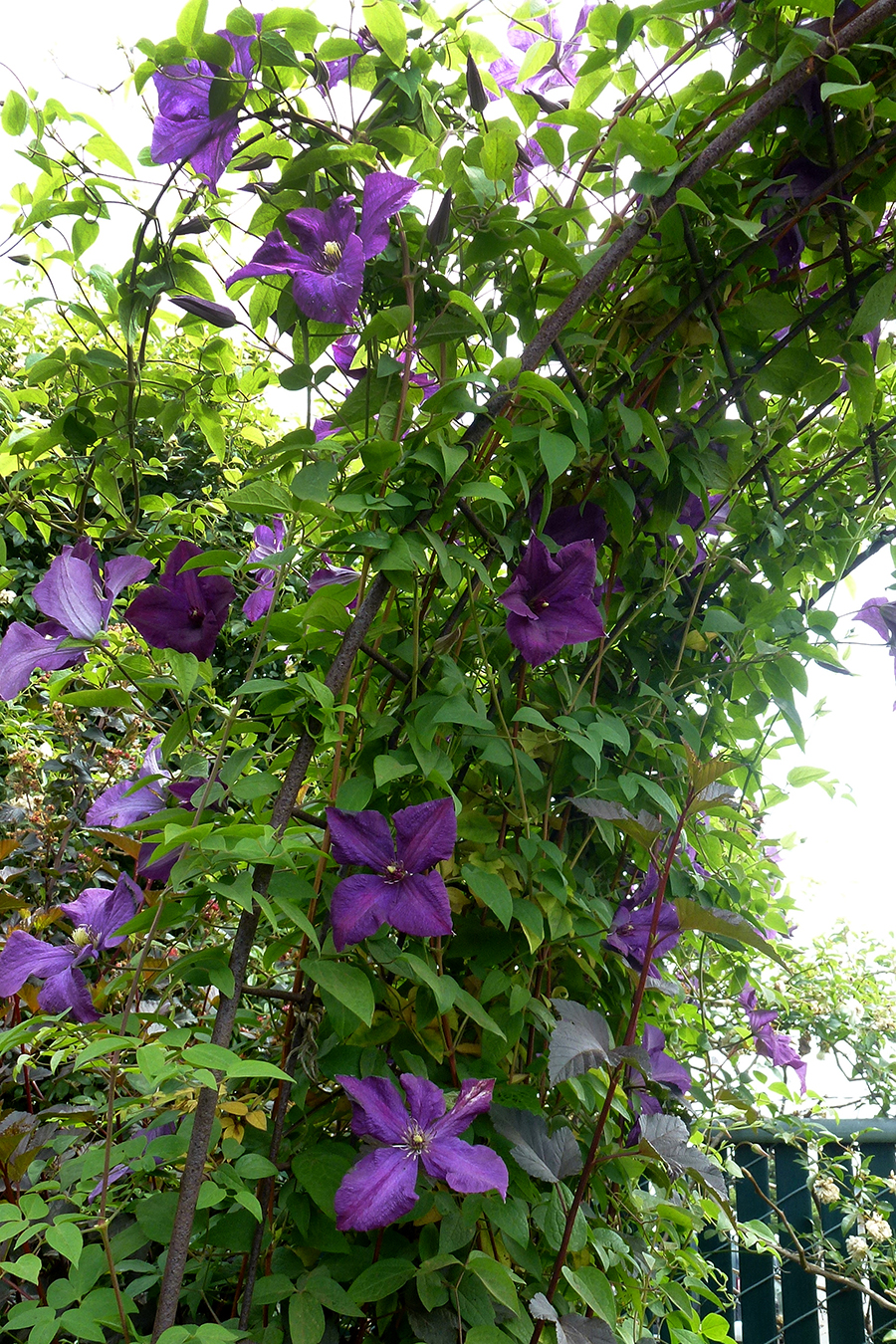
Four of the showiest large-flowering varieties offered at Annie’s are the burgundy ‘Etoile Violette’, the lavender H.F. Young’, the blood red Madame Julia Correvon and the deep purple Polish Spirit.’ These outstanding performers have been in the nursery trade for many years, proving their durability, disease resistance and versatility. ‘Etoile Violette’ features large, splayed 3” long petals of vivid burgundy, offset with mesmerizing cream-colored stamens. It blooms mid-summer, with a second entrancing performance in fall.

‘HF Young has one of the largest flowers in the clematis kingdom, each rich lavender bloom an eye-popping 7” in diameter! A prolific bloomer starting in mid-summer it, like many clematis, attracts a variety of butterflies and hummingbirds to its flowers.

Where this beauty offers a pastel palette, ‘Madame Correvon’ displays the richest wine-red blooms. A bit smaller and with just 4 petals, it nonetheless is the ultimate focal point in almost any garden. This deciduous, group 3 variety blooms on new growth, so prune to about 1’ tall in early spring for an even more impressive display the following year!

Clematis ‘Polish Spirit’ might be considered a sister to ‘Madame Correvon’, given its saturated purple flowers displayed on 4” petals, and it being a group 3 selection, so choosing one or the other may simply be – do you like dark red or vivid purple better?

Two other clematis are worth investigating. Sweet Autumn clematis (C. paniculata) is smothered in small white fragrant flowers in the late summer while the intriguing C. ‘Rooguchi’, the easiest to grow and longest blooming clematis out there, is cherished for its totally cute 2” flaring purple bells. Borne in crazy profusion from late spring to early fall, these white-throated, stiff, nodding flowers arch out on showy black stems.

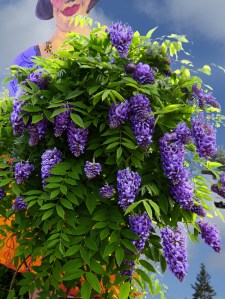
You may think you know Wisteria, most of which hail from China or Japan, but let me introduce you to an American beauty – W. ‘Amethyst Falls.’ A fantastic small-scale variety, this American wisteria tops out at only 15-20’ and 6’ across (if left unpruned). Ours is growing in a barrel and kept to 6’ tall, indicating that this showy bloomer is perfect as a stunning patio plant. Blooming bountifully in spring and intermittently in summer, its beautiful, richly colored blue-purple pinecone shaped 4-6” dense pendulous clusters are lightly fragrant. It likes sun so make sure to give it lots of light.

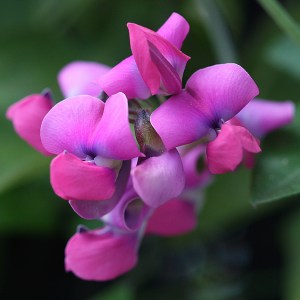
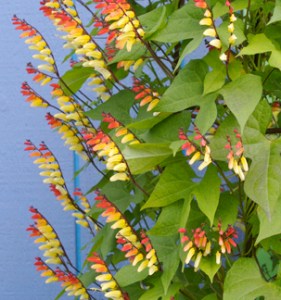
Want something showy and unique in a hurry? Cape Sweet Pea (Dipogon lignosus) is one of the fastest growing vines in the trade. This South African legume will reach 10’ in 2 to 3 months and bloom spring through fall!

Held on arching stems, the grape soda-scented pink & red flower clusters really pop against lush green, heart-shaped leaves. Despite its romantic appearance, it is perfect for covering a fence or smothering an arbor. Rich soil and full sun yields the best show but part sun will do. It may go deciduous during heavy frosts. Self-sows!

If pink and more pink is your thing, Pandorea jasminoides ‘Pink Supreme’ might be your cup of tea. Fast growing, green and glossy foliage provides the perfect backdrop for a multitude of lovely, 2” flared trumpet, soft pink blooms, each highlighted with a bright cherry throat. Smelling lightly of jasmine, this wonderful 10-15′ tall selection blooms continuously late spring to fall, peaking in mid-summer. Attracts hummers, too! Plant this evergreen vine in rich garden soil and sun/light shade and watch it easily cover a fence in a few seasons.

Vines for Screening or Problem Areas

One of the most popular uses for a vine is to provide screening or to cover a problem area. You are looking for a vine that fills in fairly densely and typically one that does so quickly. Annie’s has four lovely vines that are perfect for either use. Most notably are 3 varieties of passion vine (Passiflora species).

P. loefgrenii x caerulea is a mouthful but it produces a thicket of verdant green leaves then come late summer, beautiful purple flowers. This rare vine features reflexed 4” petals, putting the spotlight on the halo of deep purple fringe and the black center. The Gulf Fritillary butterfly thinks they’re pretty fab too, choosing this fast-growing vine as a host plant.

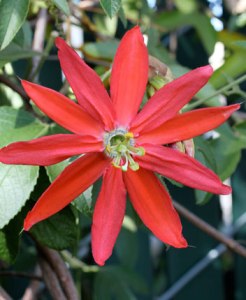
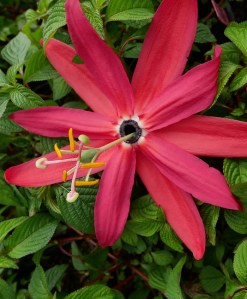
Passiflora ‘Oaklandii’ is another cross that does a great job blanketing a fence or trellis. I grew it in my yard, where it flourished with almost no care. It sports huge coral-red flowers that, en masse, look like brightly colored starfish. This evergreen vine is so dazzling when in bloom, you might in fact want to put it front and center in your garden.

That would be especially true for Sea Anemone Passion Flower (Passiflora actinia). Sporting a halo of psychedelic wavy purple fringes, this frost tender passion flower is sure to elicit cries of “What is that?!” It grows quickly, produces legions of 3” purple flowers and attracts many a butterfly to its flowers. Prefers sun but can handle a bit of shade.

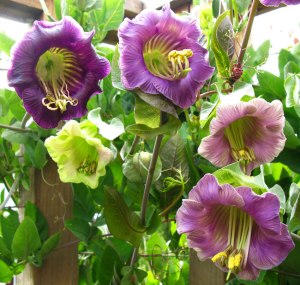
Cup & Saucer Vine (Cobaea scandens) does a similarly fabulous job of blanketing an area in dense foliage. Then, come summer, it produces Alice-in-Wonderland-like flowers – each green flower looking exactly like a cup and saucer.

But wait, for its piece de resistance, those green flowers suddenly turn a yummy purple hue. Magic! Very vigorous and needing very little water once established. Many of you will be familiar with the popular orange Black-Eyed Susan vine (Thunbergia alata) but did you know that Annie’s carries 3 other varieties of this vigorous vine? There’s the lovely oh-so-pink ‘Rose Sensation’, the reddish-orange flowering ‘Amber Stripes’ and the evocative ‘White Halo’, with its pure white petals anchored by a bullet black center. All three share the virtues of this vine – fast to establish, early to flower and long blooming and very drought tolerant once established. They prefer sun.

And just for fun, how about turning farmer and growing a grape? Annie’s offers two varieties. Vitis ‘Emeryville Pink’ is an American type grape, first found growing by the Bay in Emeryville. We’ve grown it successfully for years and it has become a beloved seasonal snack for visitors and employees alike! It grows 6-8’ its first year and then takes off in year two, giving you plenty to harvest.

Or if the fruit isn’t as important, how about the blazing red-leaved Vitis californica x vinifera ‘Roger’s Red’? The fruit is a bit seedier but is beloved by local birds and wildlife. Or you can make jam with the fruit. Large heart-shaped leaves are a soft grayish-green in summer but then turn a riotous red in fall, putting on a spectacular show. Both varieties prefer sun and are very drought tolerant once established.

Vines for Smaller Spaces

Sometimes you have an area where a rambunctious vine would simply get too big. Fortunately, there are several attractive vines that don’t get too big.

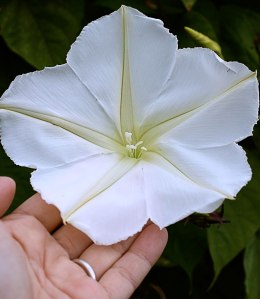
Begin with the Moonflower morning glory (Ipomoea alba ‘Moonflower’). Enormous (6”) white blooms, deliciously fragrant, open in the evening and close before mid-day. Luxurious heart-shaped leaves densely clothe this vine, which can grow to 12′ but can easily be kept to 6-8′ tall. A wonderful vine to plant near an outdoor patio or near one’s bedroom window, where one can imbibe the early-summer-through-fall blooms.

One of my favorite small vines is the quixotic Exotic Love Vine (Mina lobata). It produces delicate but bushy green leaves and then come summer, slender vines that sprout rows of small tubular flowers. Each inch long flower starts out bright red then, as the flower gets bigger the color ages to orange, yellow and finally white. With a long row of flowers on each blooming vine, one gets treated to every color on this spectrum at the same time! This petite vine is perfect for growing on a deck trellis or up a corner column. It loves the sun.

And finally, let me introduce you to the delicate and lovely Snapdragon vine (Asarina scandens ‘Joan Lorraine‘).

This beautiful Mexican vine with white-throated, velvety purple trumpets and lush delicate foliage creates a lush 8-10’ high “wall” of trident-shaped emerald green leaves. It’s a long bloomer too, filling the summer and fall skies with masses of the richest 2” flaring purple blooms. Attracts hummers! Best in part shade to morning sun and rich soil. It can be cut back in fall.

A Vine for Every Purpose

Whether you want a vine for beauty, to serve some practical purpose or to attract pollinators in your garden, there is an attractive vine for nearly every situation. The hardest task may be choosing just one!

Availability

Just so everyone knows, some of the Annie’s Annuals plants mentioned here might not be available on the week that you’re reading this blog article. Some of the plant varieties discussed are only available in our retail nursery in Richmond CA. This is generally due to us only being able to grow small crops or the fact that the particular plant does not ship well. A quick look at that plant’s page will let you know if it’s available. If not, just click the Add to Wishlist button and we’ll notify you when that plant is ready to take home.

The Importance of Fall Planting and What to Plant Now.

15 Sep

Earl Nickel,
Curious Plantsman

As summer blooms start to wind down and the days gradually get shorter, many gardeners tend to step back from their gardens. But actually fall is one of the very best times to be active and planting in the garden. Perennials, be they shrubs or smaller plants, need a bit of time to get their roots firmly established before they fashion a new growth spurt. Getting shrubs, other perennials and early blooming CA native annuals started in the fall offers several advantages. Most importantly, the cooler weather and winter rains provide the perfect conditions for them to get established. Not only will that lead to more successful blooming in the spring or summer but it will often mean that they will bloom earlier than if planted in early spring.

Planting shrubs or other larger perennials in the fall also helps you with your garden layout. Once these ‘foundation’ plants are situated, it is easier, come spring, to plant smaller perennials or annuals in coordination with these shrubs. Fall is also an excellent time to add bark mulch to your planting beds, be that to established plots or to newly planted beds. This mulch will limit the growth of weeds, help to retain moisture and for frost tender shrubs, help to insulate the roots. We can roughly divide fall flower planting into 5 categories – shrubs for sun; shrubs for shade; grasses; ground covers and vines. I’ll give examples of each below.

Shrubs for Sun

There are a great many sun-loving shrubs that benefit from being planted in the fall. Buddlejas are one of my favorites. Known as butterfly bushes, they produce 10-14” long cones densely packed with tiny nectar-rich flowers. You can find four fabulous varieties at Annie’s. These include the compact ‘Ellen’s Blue’ and ‘Hot Raspberry’. These 3-4 high and wide shrubs attract an endless parade of bees, butterflies and hummingbirds, with the former displaying purplish-violet flowers and the latter showcasing vivid magenta blooms.

Davidii ‘White Profusion’ is a full-size bush, 6-8′ H & W. The flowers are a pure white, making this plant a perfect addition to a Moon (white) Garden.

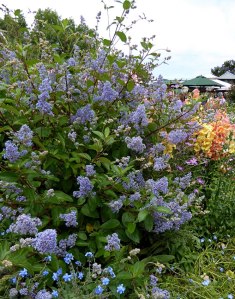
Three other shrubs benefit from being planted in the fall. California lilac (Ceanothus) can be a bit slow to establish so starting this California native evergreen in the fall has its benefits. You’ll find nearly a dozen varieties at Annie’s, with flower colors ranging from the palest lavender (‘Gloire de Versailles’) all the way to vivid purples (Ceanothus ‘Julia Phelps’ or ‘Dark Star’). At home in sun or light shade, these Ceanothus are great foundation shrubs.

If pretty foliage is your goal, Chinese Fringe Flower (Loropetalum chinense ‘Plum Delight’) is a great way to add rich burgundy tones to your garden. Reaching 4′ high and spreading to 7′ wide, this durable evergreen produces unique, pink finger-like flowers in the late spring.

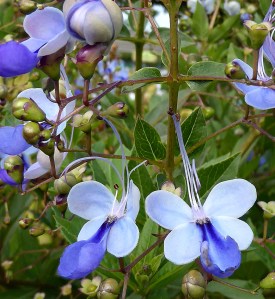
If on the other hand it’s flowers, and in particular exceptionally pretty blue flowers, are your thing, Blue Glory Bower (Clerodendrum ugandense) may be just the ticket for adding something unique to your garden. Sporting the palest blue butterfly-shaped flowers, each with a central vivid blue petal, this African native is quick to establish and equally fast to bloom. Easily reaching 7′ tall, with arching branches, it is a standout in any garden.

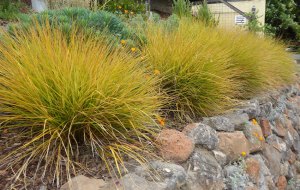
You can plant it as decorative meadow grass or use it next to a pond, since it likes some moisture. Where this Carex’s color is subtle, Orange New Zealand Sedge displays vivid coppery-orange foliage in the colder winter months. That color is best seen when this 2′ high grass is planted in sun but even in some shade, it is a great way to add contrasting foliage color to the greens and creams around it.

Shrubs for Shade

Two colorful shrubs for shade lead this group. We have available two species of Angel’s Trumpet (Brugmansia) – the slender golden trumpets of B. sanguinea ‘Inca Princess’ and the fatter, more classic bells of the white blooming B. ‘Wedding Bells.’ The latter’s blooms are an amazing 7” in diameter, with glossy yellow ribs. ‘Inca Priness’ loads up with 7” long cheerful golden blooms and when in full bloom, puts on a dazzling show.

Meanwhile, two white-blooming Hydrangeas offer part sun delights. H. arborescens ‘Annabelle’ produces huge heads (8-12” across!) of pure white flowers in spring. 4’x4′ mature plants are so prolific, you barely see the green foliage.

Dwarf Oakleaf Hydrangea (H. quercifolia ‘Pee Wee’) gets to a similar size, with panicles of alabaster white flowers, offset by highly attractive, oak-shaped mint green leaves. Even when not in bloom, this hydrangea is a standout for a shady to part sun location.

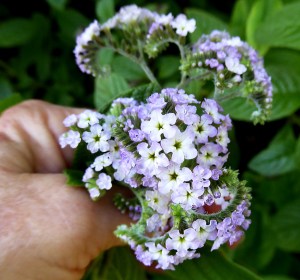
Two outstanding shrubs for shade offer enticing scents. Heliotropium arborescens and H. arborescens ‘Alba’ each produce clusters of heady, vanilla-scented flowers, the former with purple and white flowers and the latter with all white flowers. Smaller shrubs, they each top out at 3’x3′.

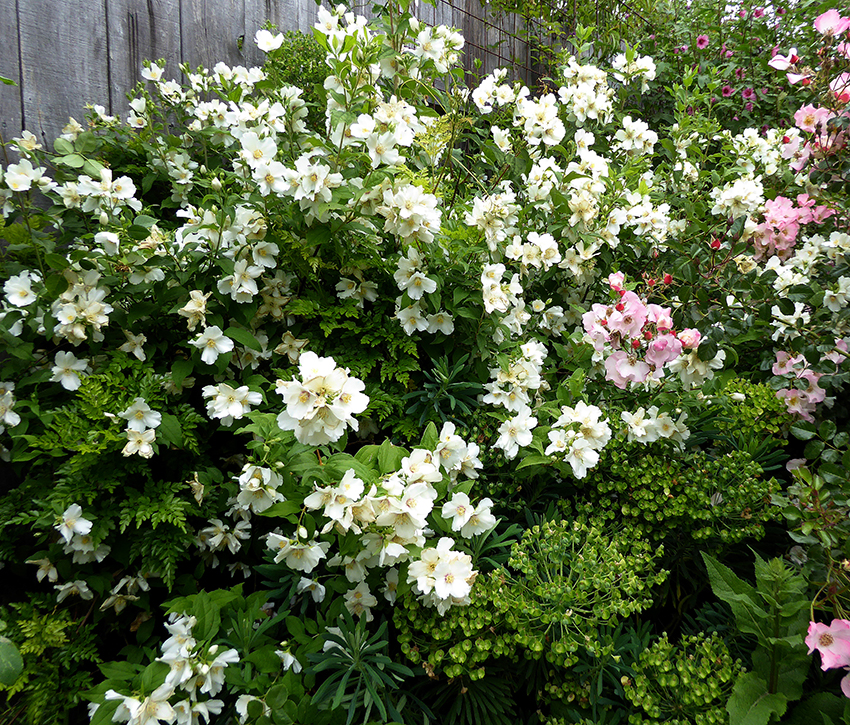
Meanwhile, Mock Orange (Philadelphus ‘Belle Etoile’) offers clusters of pure white flowers that smell intoxicatingly of ripe oranges!

Grasses

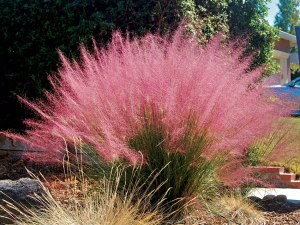
Fall is an excellent time to start ornamental grasses. Pink Muhly grass sounds like an odd common name but Muhlenbergia capillaris is one the showiest grasses you will ever grow.

Its calling card is its vivid pink seedheads, which completely smother the plant in late summer. Forming an upright 3’x3′ mound of narrow, brownish-green leaves before its flowering, this drought tolerant, durable grass is also a valuable source of seed for local songbirds.

Two other Muhlies are worth exploring – the southwest native M. dubia and M. reverchonii ‘Undaunted.’ The latter features reddish-mauve seedheads and is likewise cold hardy, very drought tolerant and long-lived.

And how about growing the state grass of California?! That would be Purple Needlegrass (Stipa pulchra). Widespread, it forms 18” high clumps whose seedheads start out purple then age to a silvery color. Nodding Needle grass (Stipa cernua) is another durable native that reaches 2′ tall and produces unique ‘bending’ seedheads.

For great foliage color, there’s no beating New Zealand Wind Grass (Stipa arundinacea). Much sought after by west coast gardeners for its golden-ginger blades, it reaches 3-4′ in height. It looks fabulous when massed and equally showy when featured in a container. A real statement plant!

Vines

Vines occupy a particular place in a fall planting scheme as many actually bloom in the autumn. That shouldn’t preclude you from planting them now and one of my favorites is Passion Flower vine (Passiflora). Whether it is an edible type (P. edulis “Frederick’) or one of many ornamentals, this vine produces some of the most unique and colorful flowers in the floral kingdom.

Annie’s selections divide themselves roughly into two groups – those with pronounced filaments (P. actinia, P. ‘Blue Horizon’ and P. loefgrenii x caerulea) and those whose parentage includes P. manicata (‘Susan Brigham’ and ‘Oaklandii’) or P. parritae (‘Cocktail Orange’ andMission Dolores’).The latter passifloras showcase large orange, coral or red flowers, with few or no filaments. Whichever you choose, the flowers are bold, eye-catching and known to attract butterflies.

Several other vines offer their own treats, be that the fragrant flowers of Pink Jasmine (Jasminum polyanthum ‘Pepita’), the vivid purple flowers of Clematis ‘Polish Spirit’ or the blazing red fall foliage of Roger’s Red grape (Vitis californica x vinifera ‘Roger’s Red).

Ground Covers

While ground covers are often overlooked when it comes to fall planting, they too can benefit from a head start. African daisies (Osteospermum) are a great example, getting a head start on spring blooming when planted in the fall. We have 3 colorful varieties, ‘3D Double Purple’, ‘Compact White’ and ‘Zion Copper Amethyst.’ The 3D Double Purple is noteworthy for its flowers not closing at night, as is the case with most Osteos.

Our California native Blue-eyed grass (Sisyrinchium) particularly benefits from a fall planting, leading to not only an earlier flowering but a more robust one as well. S. hybrid ‘Devon Skies’ not only flaunts the bluest flowers but some of the largest ones in the genus. S. bellum ‘North Coast’ has slightly smaller and more purple blooms while S. californicum offers cheerful yellow flowers.

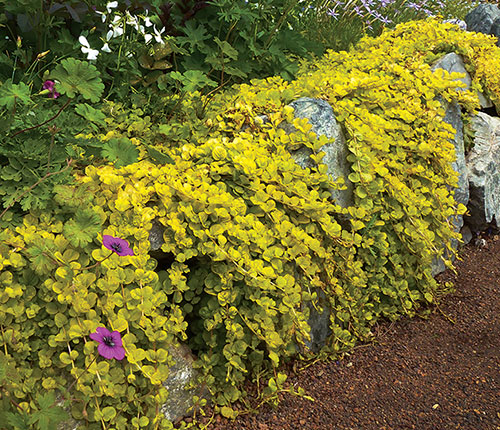
Lastly, the curiously named Golden Pennywort (Lysimachia nummularia ‘Aurea’) is a fabulous ground cover that can either spread out on level ground or cascade over a low wall. It benefits from a bit of shade and even though it loses a few leaves in winter, it fills out a gloriously gold come spring.

To Conclude

“The beauty of planting shrubs and other perennials in the fall is that you are rewarded with its benefits no matter what climate you live in, which particular plants you add or the plants being of a large size or small. So, time to get out that shovel and get going!”

Availability

Just so everyone knows, some of the Annie’s Annuals plants mentioned here might not be available on the week that you’re reading this blog article. Some of the plant varieties discussed are only available in our retail nursery in Richmond CA. This is generally due to us only being able to grow small crops or the fact that the particular plant does not ship well. A quick look at that plant’s page will let you know if it’s available. If not, just click the Add to Wishlist button and we’ll notify you when that plant is ready to take home.

Fire-Safe Landscaping with Kate Frey

19 Apr

By Kate Frey
Special Contributor

The recent fires in the Napa/Sonoma area have touched everyone in Northern California. The physical composition and appearance of our landscapes, and our relationship with them is forever changed. From wildlands, rural hillsides, to city streets, what seemed permanent and safe is vulnerable to periodic fire. Not just the built environment, but many of our trees, shrubs and gardens are gone, living elements that act to soften and aesthetically anchor houses and buildings to the earth and create a sense of place around our homes.

PastedGraphic-5

Our homes and businesses are set in and adjacent to wild landscapes. In our leisure time, we walk, bike or drive through their majestic scenes. People travel from all over the world to enjoy the atmospheric and rugged Napa Valley, and the wine region set in it. Our intense engagement with these environments has created a strong urban-wildland interface that is susceptible to fire, a natural aspect of our summer-dry landscape.

The Larger Context

It helps to understand the larger context of fire in the environment our homes and businesses are set in. Due to our long dry season without rain, low relative humidity, sometimes heat and winds, and with often-abundant fuels (vegetation), California is a fire-prone landscape. Ecosystems and plant communities have developed and evolved in this environment. Periodic fires are a natural aspect of most California ecosystems. Some are fire-dependent and require fire for seeds to germinate, renew over-mature vegetation, open forests to sunlight, and to provide nutrients for certain plants. The soft, new growth of native shrubs that grow after a fire provide much nutritious browse for animals such as deer. Bare soil and the lack of competition from shrubs and trees allow annual wildflowers to grow. But too frequent fires destroy seedbanks, and young trees and shrubs before they are old enough to set seed, and set in motion a landscape’s conversion to grasslands, a highly flammable vegetation type.

PastedGraphic-4

Fire in Plant Communities

Dry conditions, low relative humidity, and winds help create physical conditions conducive to fire. Vegetative fuels with low moisture levels, and structural elements like houses feed fires. The golden hills of California, a ubiquitous and inherent aspect of our state’s identity, are now composed of over 90% non-native grasses and forbs. We have both purposely and inadvertently converted our natural understory landscape of perennial grasses and ephemeral annual wildflowers to very flammable non-native grasses. These plants grow quickly with the advent of winter rains, set seed and die early in the spring. They are highly flammable (often called “flashy), and allow fires to spread extremely rapidly. Dried grasses are dangerous when they invade or are adjacent to shrub or chaparral plant communities as the grasses act as ladders into the flammable shrub overstory. These grasses also dry much earlier in the season than other vegetation, and so extend the fire season greatly.

Chaparral, the most common plant community in the state, is composed of densely growing shrubs such as manzanita, chamise, toyon, scrub oak, and Ceanothus that form a closed stand over time. It is a fire-dependent ecosystem, yet fires historically naturally occur in these systems only about once or twice a century. Fires are often severe, eliminating most standing vegetation. Many shrubs and trees of this ecosystem either sprout from the base after a fire, or their seeds are stimulated to grow by fire and the resulting bare soil. Fires rejuvenate these areas. In conifer forests, fires were more frequent, usually patchy, and lighter in intensity, mostly consuming the understory and young trees with branches that reach the ground. With the advent of effective fire suppression, forests are widely considered more dense and even-aged than they were naturally, and consequently fires are now often severe and enter and spread in tree crowns. In oak woodlands, trees and shrubs both grow singly and in clumps. Older hardwood trees such as oaks, madrone, and California bay often have no lower branches due to age. They usually grow in wide expanses of dry grasses that are highly flammable. Winds can act to move flame from ground level into tree canopies.

How do fires start?

Over 90% of fires are started by human activity. Mowing, powerlines, and sparks from cars, cigarettes, and campfires, cause fires far more frequently than do lightning strikes. As we have seen, winds have a great influence in the generation and severity of fires and the catastrophic speed at which they move, and can cause devastation in areas never considered at risk.

PastedGraphic-3

We can affect how fire-safe our landscapes are. Choosing appropriate plants for a fire-prone landscape, strategically siting and pruning plants, minimizing dry fuels such as grass, and adequately watering plants can have an effect on how landscapes behave in the event of a fire. Larger landscapes need to have defensible space around structures. Defensible space is defined as space where the vegetation has been designed or modified and maintained to reduce flammability, and where firefighters can defend a structure.

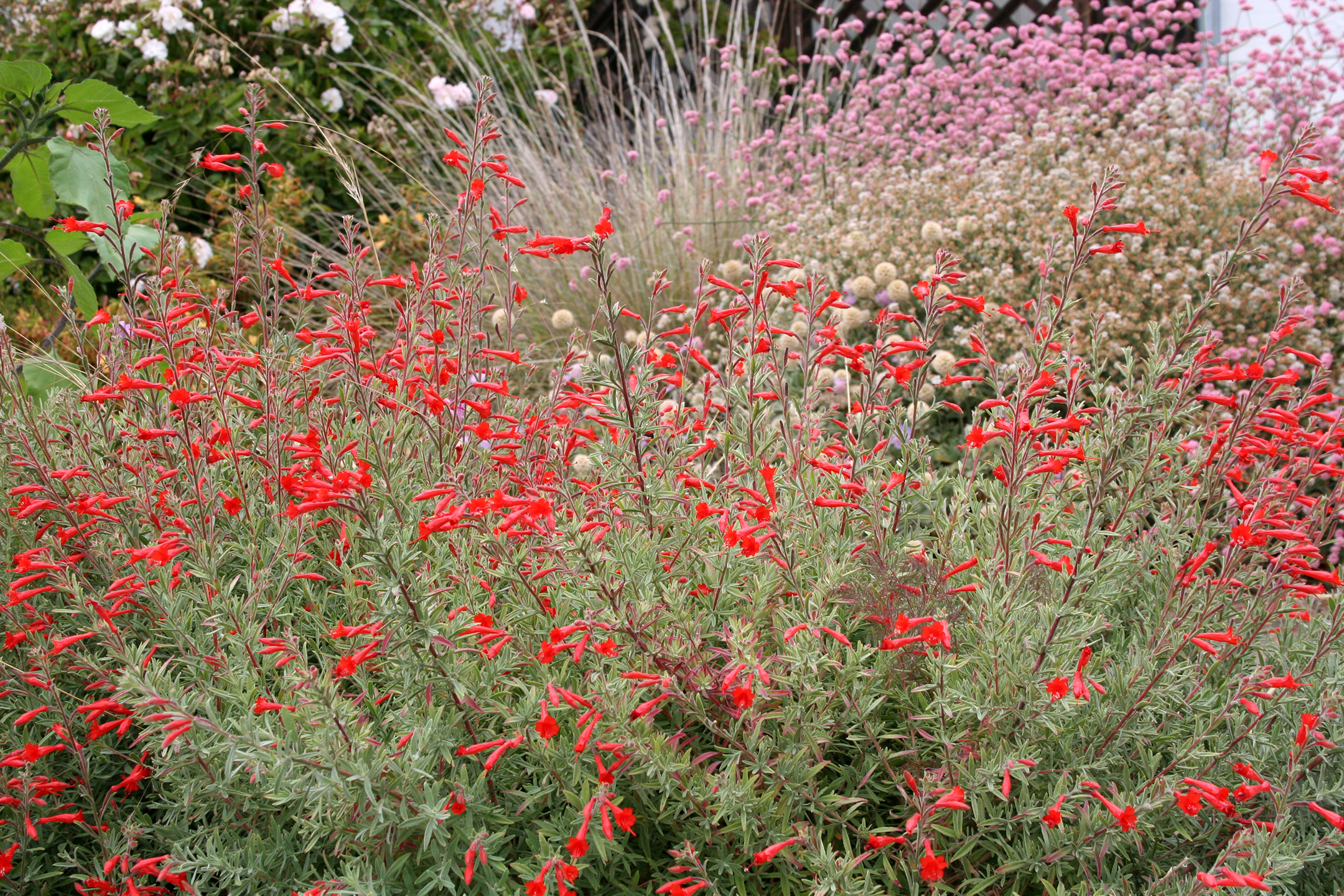
zauschneria_californica_horiz

Urban and rural areas have different laws and concerns about their properties and gardens. In rural areas existing fire ordinances govern how landscapes are managed. Most break down areas of concern into defensible space zones corresponding to distance from houses or structures. In an urban or suburban setting, where houses are closely spaced, and lot sizes are small, houses themselves form the vast majority of combustible fuels. In these spaces, we can still work to minimize our gardens possible contribution to further ignition of homes. Minimizing the use of highly flammable trees such as Monterey pines, junipers and eucalyptus, irrigating our plants well, maintaining plants (trees, vines, shrubs and groundcovers) free of dead leaves and stems, and thinning dense vegetation will all contribute to a more fire safe environment. 

Defensible Space Zones for Wildfire:

Zone 1: 1-30 feet from structure.

  • Remove dead plants and dead grass/weeds.
  • Remove any overhanging tree branches over roof or touching house.
  • Trees should have a 10-foot space between them.
  • Use low flammability shrubs under windows and around decks.
  • Use gravel mulches. Compost can be placed around plants.
  • Water plants well.

Zone 2: 30-100 feet from structure.

  • Dead grasses mowed to four-inches.
  • Fallen leaves/needles/small branches and plant debris can be no more than three-inches deep.
  • Eliminate ladder fuels to trees. Limb up trees to six-foot from ground.
  • Create horizontal space between trees and shrubs. Space trees and shrubs widely. (See CalFire website for details). Create non-contiguous plantings.
  • Create vertical space in between trees and shrubs. Remove shrubs under trees that could act as ladder fuels. (See CalFire website for details).
  • Use low flammability mulches such as decomposed woodchips or composted greenwaste.

Choosing and maintaining fire-resistant plants and gardens

All plants can burn!

  • Irrigate your plants adequately. A high-moisture content acts to buffer flammability. Well-irrigated plants require more energy to ignite and sustain combustion.
  • Maintain plants free of deadwood/twigs/stems.
  • Thin dense tree and shrub canopies to reduce fuels.
  • Limb up trees 6-10 feet from ground level to minimize ‘fire ladder’ effect. Limb up shrubs so foliage does not touch ground.
  • In wildlands thin chaparral shrubs. Base-sprouting plants like coyote brush, chamise and coffeeberry can be cut down every few years in fall to reduce fuel load and keep vegetation young.
  • Chose fire-resistant plants for your garden. Fire-resistant plants are open in growth habit, don’t accumulate dead wood/leaves/stems, and are free of flammable resins/oils and turpenes.
  • Use more low-growing plants (less than two-feet in height) than upright shrubs or trees.
  • Space plants adequately for each fire zone and around structures. On large lots and properties, the immediate critical 30-foot area around houses should have just widely spaced, well-irrigated specimen trees and low plantings free of mulch. Sprinkle compost around plants for soil fertility. From 30-100 feet from houses, space trees 20-40 feet apart. Space shrubs widely. Low plantings should not be contiguous.
  • Thin or remove highly flammable plants- such as many conifers, especially near structures. Deciduous trees are less flammable.
  • Have adequate numbers of plants with deep and extensive roots (such as native plants), to hold and protect soil during winter rains- especially on slopes.
  • Use mulches with low flammability. Mulches that have large air spaces between particles or pieces are more flammable. Shredded barks can be highly combustible. A two-inch layer of woodchips, and even better, composted woodchips or composted greenwaste have low flammability and tend to smolder rather than flame. Compost has less flammability still as particles are very small and closer in composition to that of soil. Consider installing microsprinklers in mulched areas so mulch can be moistened during times of red-flag fire warnings. Red-flag warnings are when humidity is less than 19% and winds over 25 mph. Intersperse mulch with non-combustible materials such as pavers, decomposed granite, gravel or rock.
  • Mow annual grasses and weeds in a 100 feet perimeter around structures to 3 inches in height before they are completely dry to minimize any fire spread and fire ladder effect.


Further information:

The Napa Communities Fire Wise Foundation Defensible Space

http://www.napafirewise.org/DS%20Download/defensable-space-live/index.html

Cal Fire

http://www.fire.ca.gov

Home Landscaping for Fire UCANR Publication 8228

http://ucanr.edu/sites/cfro/files/167774.pdf

Defensible Space State Law: Public Resources Code 4291

http://leginfo.legislature.ca.gov/faces/codes_displaySection.xhtml?sectionNum=4291.&lawCode=PRC

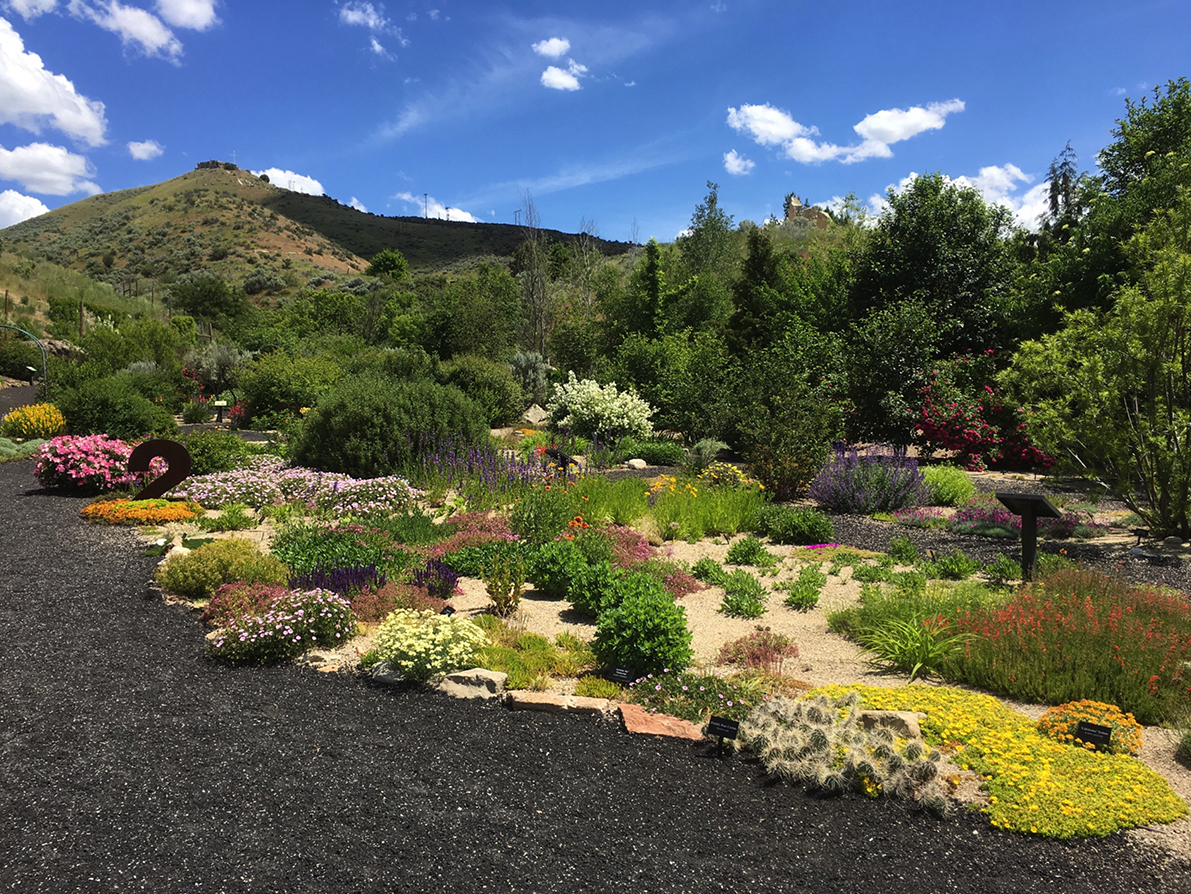
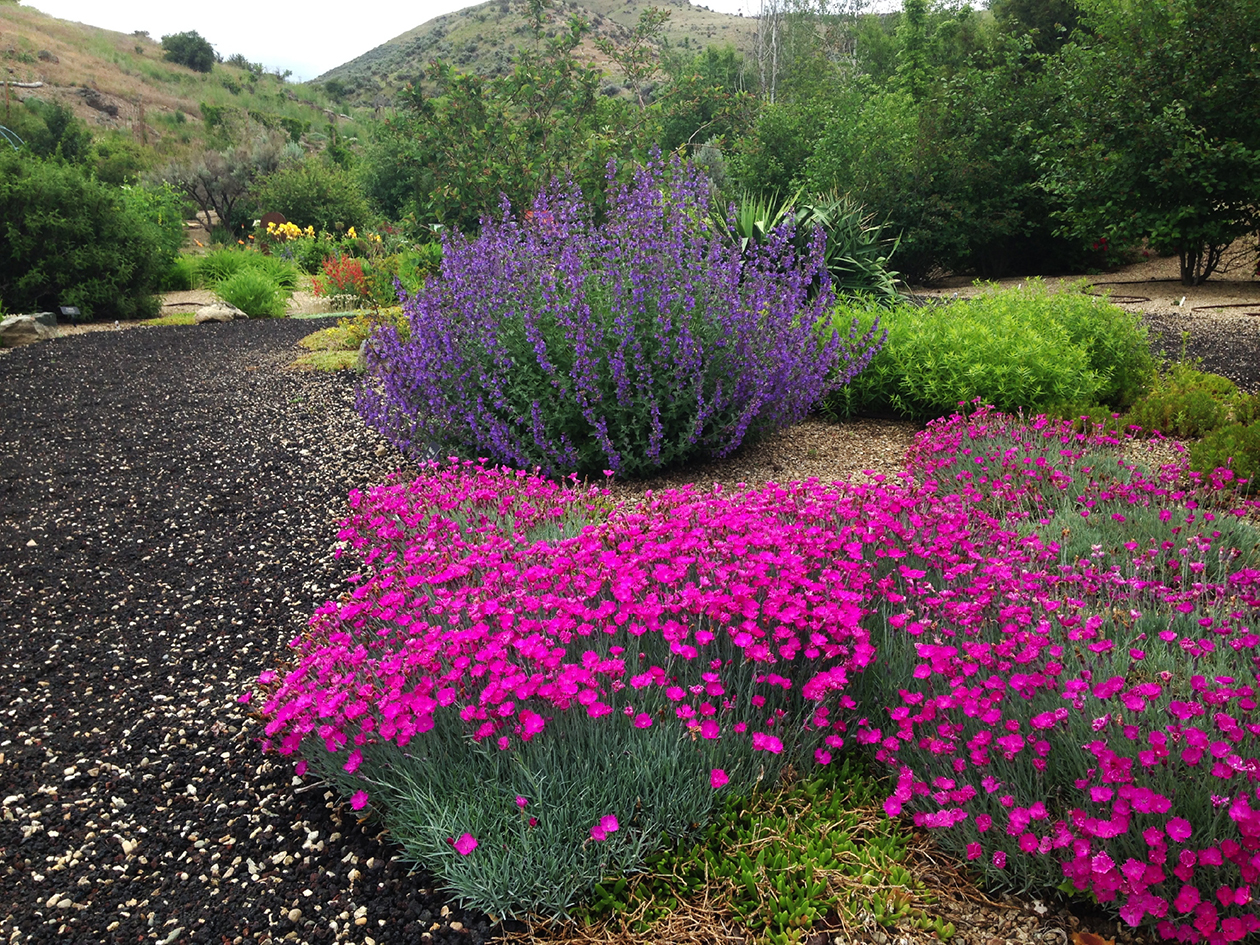
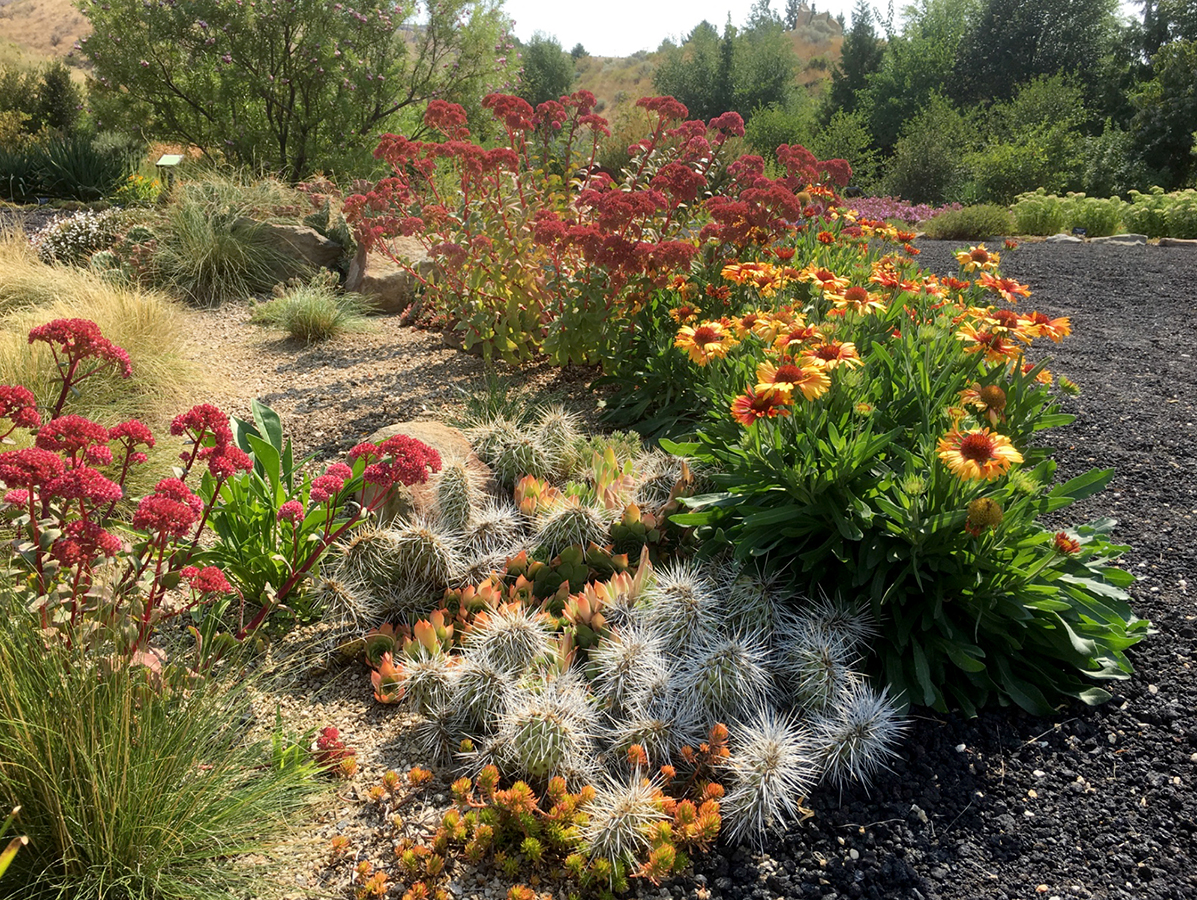
The photos are all from Brett Van Paepeghem and are of his beautiful fire-wise garden at the:

College of Western Idaho – Idaho Botanical Garden
2355 Old Penitentiary Rd.
Boise, ID 83712

The Firewise Demonstration Garden at the College of Western Idaho – Idaho Botanical Gardens (IDG) was the first of Firewise demonstration gardens developed in Idaho to show homeowners how they can live on the edge of wildlands more safely and beautifully.

This Firewise Garden was born out of the 2000 fire season, the worst at the time since 1910. Seven million acres burned and fires caused $10 billion in loses – including entire neighborhoods in Los Alamos, NM. Bureau of Land Management (BLM) botanist Roger Rosentreter, now retired, got the idea from a similar garden he saw in San Diego. Many of the plants in the San Diego garden would not grow in Idaho’s climate, so Dr. Rosentreter convinced the BLM to partner with Boise State University, the Idaho Botanical Garden and later the College of Western Idaho and Idaho Firewise, to install and manage this garden in what once was an ugly weed patch.

The garden was opened to the public in 2008 and is currently visited by over 100 thousand people a year.

The BLM Firewise Garden was developed just outside of the Lewis and Clark Native Plant Garden Wetlands area. It is a partnership between the Bureau of Land Management, College of Western Idaho’s Horticulture Program, and the Idaho Botanical Garden. The Garden now supports more than 300 species and cultivars of plants, both native and non-native.

Brett Van Paepeghem is a 4th generation Idaho native. He holds an AAS in Horticulture and BAS in Biology with specialization in Botany and Ecology from Boise State University. Brett has worked for the USFS on the Payette National Forest as a Range Tech with the Noxious Weed Control Team and 7 years at the Idaho State office BLM as a Plant Biological Tech. In June of 2014 he joined Idaho Firewise as the Southern Idaho Project Manager where he manages the BLM/CWI/IBG Firewise Garden and has collaborated with various agencies on the development of several new Firewise Demo Landscapes throughout Southern Idaho.


Succulent Container Madness!

9 Dec

You can shove succulents in anything!

Hi all!  Megan here to show you some fun gifty ideas with succulents. I’ll shove a succulent in almost anything, whether it be a grill that nobody’s used for years, or an old wagon I picked up for five bucks at a garage sale.  The possibilities are endless! First off,  I want you to know that in many cases these are not permanent plantings (this is especially true for terrariums). Several months or even years down the road, depending on how quickly the succulents you plant grow, it’s extremely likely that your creations will benefit from a little fluff. I redo the wagon & the grill once or twice a year. Think of your succulents like sculptural elements & have fun. It’s not like you’re deciding where to plant a tree that you’ll have to live with for many a year.

Succulent Roos

The ultimate key to succulent happiness in the great outdoors (sorry folks in freezing locations) is drainage. Non-draining containers + rain = rotty mush. Pick up a ceramic bit & you can drill through almost anything so that the water can flow. These kangaroos came from Goodwill & after a quick meeting with the drill they drain perfectly. When it comes to drilling holes, higher quality ceramic items tend to be more challenging to drill through & glass is the trickiest, but it’s all possible if you’re willing to take the risk of a stray break here & there. Load up on inexpensive containers at your local thrift store. I’m a big proponent of succulent potting mix  to achieve ultimate drainage.  To create the roos above all I did was drill holes in their booties, fill with cacti/succulent mix & stick cuttings.  Easy, peasy. These cuties would work inside in a bright location, too!

Graptopetalum paraguayense paradise

One of my all time favorite succulents for containers are the creamy pinkish blue rosettes of Graptopetalum paraguayense. Gardening in almost pure sand, two blocks from Ocean Beach in nearly frost free San Francisco means lots & lots of succulents are happy campers in my backyard. Okay, it’s succulent heaven, but before moving to California I actually grew a wide array of succulents in my living room closet with lights. Taking cuttings is easy. Just snip, snip & you’re done. If you’re a rule follower, snip your cuttings at least a day in advance so the cuts have time to dry out & heal over, preventing bacteria, etc … I normally don’t do this due to patience issues & things seem to turn out fine.

Oscularia deltoides & Satureja douglasii

Another one of my favorite succulents for cutting is Oscularia deltoides. It seems to benefit from a little haircut now & then anyways. Here it is escaping the border with a San Francisco native that smells like heaven, Satureja douglasii.

Aeonium simsii

Aeoniums seem to put up with indoor action fairly well & Aeonium simsii is one of the highest rated of the bunch for indoor happiness. Love the eyelashes on the leaf margins.

Succulent Assortment

Over the past few years of putting together succulent containers & terrariums, I’ve found that often times less is more. I used to shove ten different succulents in an itty bitty container & let them battle it out. The results were often scraggy & sad.  I tend to go for lower growers that form a dense mat, or splashy bigger rosettes.

Vintage Succulent Containers

A couple holes in the bottoms, some dirt, plants & they’re ready to go! Since these were taken as cuttings they have no roots, which means they have nothing to take up water with. Don’t fret, the water stored in the leaves will hold them over until they pop out new roots from the stems jammed in dirt. No fancy rooting hormones needed! I  don’t even water containers composed of cutting based succulents for the first two weeks or so, to let them root out a bit. A sunny to part sunny spot is all they need. Indoors, they like a bright window.

Graptopetalum paraguayense Dino-land

Terrariums are all the rage these days, but I’ll tell you upfront – they’re a little trickier to keep happy. The key to keeping a container with no drainage is water control. Overwatering is a sure fire way to rot the roots out & keep a fungus gnat family happy, but if you’re using glass it’s pretty easy to keep an eye on how much moisture is making it to the bottom of the container. I like to use a spray bottle. I’ll spray a bunch then wait a couple minutes to see how deep the water seeps in and spray more if needed.

Ornament Fun

Many hardcore succulent folks think it’s cruel & unusual punishment to put plants that like free draining soil & low humidity in glass, but I’ve had numerous successes with succulents in non-draining situations. They’re very forgiving. Planting wise, it’s easy. I like to use pretty rocks or gravel on the bottom for a wee bit of drainage space, plus it looks cool. Some folks add a sprinkle of horticultural charcoal in for good measure before adding the succulent potting mix in. I don’t. The next step is getting the plants in there. I like using rocks as a topdressing not only because they’re pretty, but they help keep the plants where you want them. If your container is small, it’s handy to have a pair of chopsticks for nudging stuff around.

Succulent Swan

Wishlist alert! I couldn’t resist showing ya’ll this adorable little newbie Echeveria amoena. It’s still a baby here at the nursery, but it will be available down the road. I absolutely LOVE this plant.  It’s adorable with or without blooms & loves life in containerville. I’ve got plenty more ramblings about stuffing succulents in things on my garden blog Far Out Flora & am happy to answer any questions you may have, just post a comment.

Terrarium Fun Links: Going Glass Globe Crazy, Want to Win Succulents? (old contest), Totally Terrariums, Glass Jar Terrariums, Gardening in Glass

Succulent Container Links: Rearranging Rocks, Cranking Out Containers, Succulent Gardens Containers, Succulent Pots, Cool Creative Containers